Making Insurance Simple, One Insight at a Time.

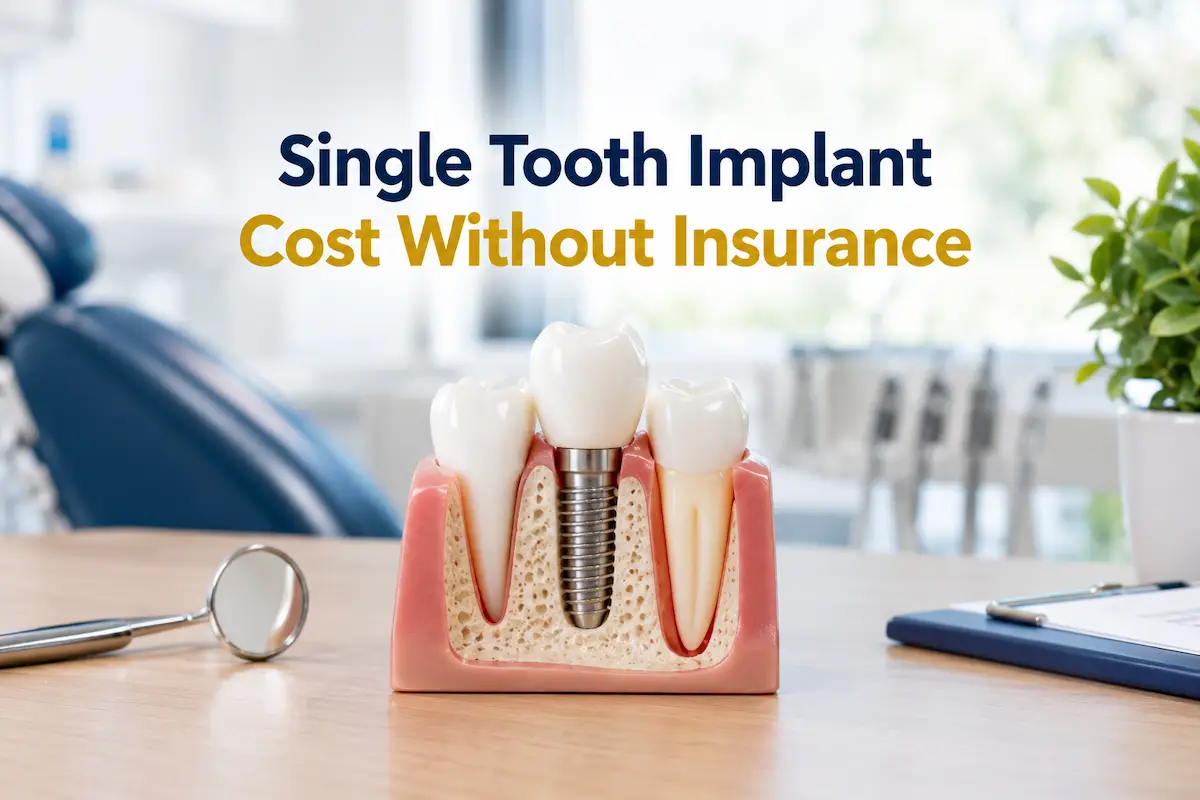
Single Tooth Implant Cost Without Insurance: Avoid Costly Surprises
Wondering about the single tooth implant cost without insurance? Avoid unexpected bills with our 2026 breakdown of procedural fees, regional rates, and dental discount plans.
Quick Summary
The single tooth implant cost without insurance typically runs $3,000 to $6,000 per tooth in the United States, according to DentalPlans.com’s 2026 estimates, and that price should include the implant post, the abutment, and the crown. Extractions, bone grafts, and sinus lifts are usually billed on top. Most dental plans treat implants as elective and cap benefits at around $1,000 to $1,500 a year, and Medicare has not covered routine dental care since 1965.
This guide breaks down the single tooth implant cost without insurance, compares implants with bridges and dentures, explains what insurance can and cannot do, and lists practical ways to pay.
Table of Contents
Table of Contents
1. What Is the Single Tooth Implant Cost Without Insurance?
The single tooth implant cost without insurance is the price of three parts working together: the implant post, which is a titanium screw placed in the jawbone; the abutment, which connects the post to the tooth; and the crown, which is the visible replacement tooth. DentalPlans.com’s 2026 estimates put the complete package at $3,000 to $6,000 per tooth. Healthline, in an article reviewed by a dentist in 2021, says the implant itself costs around $2,000 to $3,000 and that with the abutment and crown you may pay as much as $6,000 per tooth.
Two sources five years apart agree on the same ceiling, which makes $6,000 a reasonable upper planning figure for the single tooth implant cost without insurance in a straightforward case.
| Item | Typical US price | Source |
|---|---|---|
| Complete single implant (post, abutment and crown) | $3,000 to $6,000 | DentalPlans.com, 2026 |
| Implant post alone | $2,000 to $3,000 | Healthline, 2021 |
| Post, abutment and crown at the high end | Up to $6,000 per tooth | Healthline, 2021 |
| Simple tooth extraction | $100 to $400 per tooth | DentalPlans.com, 2026 |
| Surgical tooth extraction | $200 to $600 or more | DentalPlans.com, 2026 |
| Bone graft or sinus lift | Extra cost; no reliable average published, so ask for a separate quote | DentalPlans.com; Healthline |
| Several teeth on implants (for example a bridge) | $3,000 to $30,000 or more | DentalPlans.com, 2024 |
| Full arch of teeth on implants | $20,000 to $60,000 per arch | DentalPlans.com, 2024 |
Sources: DentalPlans.com (a company that sells dental savings plans), “How Much Are Dental Implants Without Insurance?” (August 2024) and “Costs of Common Dental Procedures Without Insurance” (2026); Healthline, “Dental Implant Procedure: What to Know” (May 2021). Ranges are estimates and vary by dentist and location.
Why You May See Lower Numbers Elsewhere
Lower figures circulate for two reasons. Some are older: Healthline’s dentures-versus-implants article attributes $1,600 to $2,200 per tooth to the American Dental Association without a date, and its denture prices cite a 2016 ADA fee survey, so prices have almost certainly moved since. Others come from advertisements that cover only the post. When you compare quotes, ask the office to list the post, abutment, crown, imaging, and any extraction or grafting separately, so every quote for the single tooth implant cost without insurance covers the same things.
Front Teeth and Back Teeth
Many patients ask whether a front tooth costs less than a molar. None of the sources we reviewed publish separate prices by tooth position, so we cannot give a different single tooth implant cost without insurance for front teeth and molars. Ask your dentist whether your tooth’s location changes the plan, since back teeth bear more chewing force and front teeth have to match neighboring teeth closely.
2. What Raises or Lowers the Price
The headline number covers a routine case. Several things can push your actual single tooth implant cost without insurance above it.
Extractions
If the damaged tooth is still in your mouth, it has to come out first. DentalPlans.com’s 2026 estimates put a simple extraction at $100 to $400 per tooth and a surgical extraction at $200 to $600 or more, so this step alone can add a few hundred dollars to the single tooth implant cost without insurance.
Bone Grafts and Sinus Lifts
An implant needs enough healthy jawbone to hold it. Healthline notes that if your jawbone is too thin or soft, a bone graft or another procedure may be suggested before the implant is placed, and DentalPlans.com says grafts and sinus lifts can raise the total. We found no reliable published average price for either one, so we have not guessed. Ask for it as its own line item, because a graft can change the single tooth implant cost without insurance you were first quoted.
Provider, Region, and Crown Material
Prices differ between general dentists and specialists such as oral surgeons and periodontists, and between regions. We found no reliable state-by-state ranking, so the best approach is to get written quotes from two or three local offices and compare each single tooth implant cost without insurance line by line. The crown material and the dental lab fee also affect the quote, so ask what the crown is made of and whether lab costs are included.
Treatment Abroad
Some patients price treatment in other countries to save money. Weigh the full cost, including travel, time away from work, and what happens if a complication needs follow-up care when you are back home, before assuming a lower single tooth implant cost without insurance abroad is a real saving.
3. The Implant Procedure and Timeline
The American Dental Association’s MouthHealthy guide to dental implants describes an implant as a post surgically placed in the upper or lower jaw, made of titanium and other materials that are compatible with the human body. For a single tooth, the dentist customizes a new tooth, called a crown, to attach to the post, and that crown is part of the single tooth implant cost without insurance.
Consultation and Planning
The process starts with an exam and imaging so the dentist can check your bone and plan where the post will go. This is also the visit where you should get the written quote for your single tooth implant cost without insurance.
Surgery and Healing
After any extraction or grafting, the post is placed in the jawbone. The bone then grows around it and holds it in place. Healthline says new bone growth takes about 2 to 6 months and describes the full process as around 3 to 9 months. The ADA says some patients wait up to several months before replacement teeth can be attached, while others can have the implant and replacement tooth placed in one visit. A temporary crown, bridge, or denture may be used while the permanent tooth is made.
Who Is a Good Candidate
The ADA says your health matters more than your age. Chronic illnesses such as diabetes or leukemia may interfere with healing, and tobacco use can slow it. If you smoke or have a long-term condition, raise it with the dentist before you commit to the single tooth implant cost without insurance.
4. Implants vs Bridges and Dentures
Cost is only part of the comparison. The cheaper options often need to be replaced or adjusted sooner, so the single tooth implant cost without insurance should be weighed against how long each choice lasts.
| Option | Typical cost | How long it lasts | Main trade-off |
|---|---|---|---|
| Removable flipper | $300 to $600 for budget versions | Described as the least durable option | Lowest price, but the least durable and comfortable choice |
| Removable partial denture | $1,000 to $2,500 | Needs adjustment or replacement over time | Lower up front, but removable and may need refitting |
| Dental bridge | $1,500 to $5,000 or more | Often replaced every 5 to 7 years; can last more than 10 | Neighboring teeth must be prepared to hold it |
| Single tooth implant | $3,000 to $6,000 | 15 years or more; Healthline says 20 or more is possible | Highest up-front cost and needs enough healthy jawbone |
Sources: DentalPlans.com, “Costs of Common Dental Procedures Without Insurance” (2026); Healthline, “Dental Implant vs. Bridge” (2021) and “Dentures vs. Implants” (updated February 2026). Ranges are estimates and vary by dentist and location.
Healthline says a bridge usually has to be replaced about every 5 to 7 years, although it can last more than 10, and that a bridge can damage the healthy teeth around the missing one because they must be prepared to hold it. It says an implant can last 15 years or more and does not harm neighboring teeth. A separate Healthline comparison of dentures and implants, updated in February 2026, says implants could provide 20 or more years of service, while dentures may need adjustments or replacement over time.
The trade-off runs the other way for bone. Healthline notes that dentures fit even with low bone density, while implants require enough jawbone to support the post. If you have lost bone, a graft may be needed, and that graft adds to the cost. Ask your dentist to price the whole replacement cycle, not only the first single tooth implant cost without insurance, so you can compare options fairly.
5. Does Any Insurance Pay for an Implant?
Most dental plans treat implants as elective or cosmetic, so plan on the full single tooth implant cost without insurance until a written coverage decision says otherwise. DentalPlans.com’s May 2026 guide says many plans cover implants only in small part, that higher-tier plans may reimburse around 50% up to an annual maximum, and that most plans cap benefits at $1,000 to $1,500 per year. Waiting periods of six to twelve months before major work is covered are common on new plans, and a missing tooth clause may exclude a tooth lost before your coverage began.
Medical Insurance
If you lose a tooth in an accident or because of a medical condition, medical insurance may cover part of the procedure, but it generally requires documentation that the treatment is medically necessary. Ask both your dental and medical insurers for a written coverage decision before treatment starts. To understand how different plan types work, see our 2026 Health Insurance Guide: Common Coverage Mistakes to Avoid.
Medicare and Medicaid
KFF reports that Medicare has not covered routine dental care since its enactment in 1965, although some Medicare Advantage plans offer dental benefits that may include dentures or implants. Check a plan’s coverage documents before assuming either way. Adult dental coverage in Medicaid is optional for states under federal law, and KFF’s review of state programs found wide variation, from extensive benefits to coverage limited to pain relief and emergency care. Contact your state Medicaid office for what applies to you.
6. Ways to Pay for an Implant Without Insurance
Even without coverage, there are ways to spread out or reduce the single tooth implant cost without insurance.
Dental Discount Plans
A dental savings plan is a membership, not insurance. DentalPlans.com, which sells these plans, says they can typically reduce implant costs by about 20%. That figure comes from a company with a stake in the sale, so confirm that your dentist participates and that implants are included before you pay for a membership.
Payment Plans and Medical Credit
Many offices offer in-house payment plans or work with third-party lenders that let you divide the single tooth implant cost without insurance into monthly payments. Read the terms for interest, fees, and whether a promotional 0% rate can turn into deferred interest on the full balance if you miss the deadline.
HSA and FSA Dollars
IRS Publication 502 treats dental treatment as a qualifying medical expense, so a health savings account or flexible spending account can pay for it with pre-tax dollars. Confirm with your plan administrator that your implant qualifies. If you also need orthodontic work, our How Much Do Braces Cost Without Insurance? 2026 Cost Guide explains how to budget for it.
Dental Schools and Community Clinics
Many dental schools run teaching clinics where supervised students treat patients at reduced fees, and community health centers sometimes offer sliding-scale dental care. Availability for implants varies, so call and ask what they offer and how long the wait is.
7. Frequently Asked Questions
How much is the single tooth implant cost without insurance?
DentalPlans.com’s 2026 estimates put it at $3,000 to $6,000 per tooth for the implant, abutment, and crown. Healthline gives a similar upper limit of about $6,000 per tooth. Extractions, bone grafts, and sinus lifts are extra.
What is the cheapest way to replace one missing tooth?
A removable flipper is usually the lowest-cost option, with budget versions costing $300 to $600 according to DentalPlans.com. Healthline describes flippers as the least durable replacement, so the lower price comes with trade-offs.
Is paying the single tooth implant cost without insurance worth it?
That depends on your budget, your bone health, and how long you want the repair to last. Healthline says implants can last 15 years or more and do not damage neighboring teeth, but they cost more up front and require enough jawbone. Your dentist can tell you which option fits your mouth.
Why is the single tooth implant cost without insurance so high?
You are paying for surgery, imaging, the titanium post, a connecting abutment, and a custom crown, usually across several appointments. Any extraction or grafting adds to the total.
How long does a dental implant last?
Healthline says an implant can last 15 years or more, and its 2026 update says implants could provide 20 or more years of service. The crown may need replacement sooner if it cracks or breaks.
Can one implant replace more than one tooth?
A dentist can sometimes use implants to support a bridge that replaces several teeth. DentalPlans.com puts multiple-tooth implant work at $3,000 to $30,000 or more, and a full set at $20,000 to $60,000 per arch, so the plan depends on your case.
Does Medicare or Medicaid cover implants?
Original Medicare does not cover routine dental care. Some Medicare Advantage plans offer dental benefits, and Medicaid adult dental coverage varies by state. Check your plan or state program directly, because without coverage you pay the full single tooth implant cost without insurance.
What should a written implant quote include?
It should itemize the post, abutment, crown, imaging, any extraction or graft, follow-up visits, and what happens if the crown needs adjusting.
8. Conclusion
The single tooth implant cost without insurance usually lands between $3,000 and $6,000, with extractions, bone grafts, and sinus lifts adding to the bill. Implants cost more than bridges and flippers up front but can last longer, so compare the whole replacement cycle. Whatever your final single tooth implant cost without insurance turns out to be, get itemized written quotes from more than one office, ask your dental and medical insurers for written coverage decisions, and explore payment plans, HSA or FSA funds, and dental school clinics before you decide.
Disclaimer: This information is provided for general educational purposes only and does not constitute professional dental, medical, insurance, or financial advice. Prices, insurance coverage, and program eligibility vary by provider, location, and plan and change over time. Always confirm costs with a licensed dentist and coverage details with your insurer or a licensed insurance professional before starting treatment.