Making Insurance Simple, One Insight at a Time.


Insurance Mediation Directive: Guide to Requirements & IDD
Master the Insurance Mediation Directive (IMD) requirements and learn how the transition to the IDD impacts regional markets. Discover more.
Quick Summary
The Insurance Mediation Directive (IMD) established the initial baseline for how insurance products are distributed and regulated across Europe. Designed to eliminate market fragmentation and elevate consumer protection, the directive introduced strict standards for professional registration, competence, and ethical conduct. As the market evolved, this framework faced structural challenges, ultimately leading to its replacement by the more comprehensive Insurance Distribution Directive (IDD). For informational platforms and industry professionals alike, mastering the core provisions of these shifting directives is essential for understanding modern compliance, cross-border operations, and the future of Insurance Mediation Directive regulation.
Table of Content
Table of Contents
Insurance Mediation Directive Overview
History and Development of the Insurance Mediation Directive
The formal journey of structured Insurance Mediation Directive distribution regulation began with the introduction of the Insurance Mediation Directive, officially designated as Directive 2002/92/EC. Prior to its implementation, the European insurance market was highly fragmented, with each member state enforcing vastly different rules for intermediaries. The European Union introduced the IMD to establish a single, harmonized market for financial services, making it easier for businesses to operate across borders while maintaining a baseline of professional accountability.
Comparison with the Insurance Distribution Directive
While the IMD laid the groundwork, it primarily targeted traditional insurance brokers and independent agents. Over time, new digital sales channels, comparison websites, and direct-to-consumer models emerged, creating regulatory blind spots. This gap necessitated a shift to the modern Insurance Distribution Directive (IDD), which expanded its scope to regulate any entity selling or advising on insurance products, ensuring a level playing field across all distribution channels.
Key Provisions and Requirements
Professional Registration and Competence
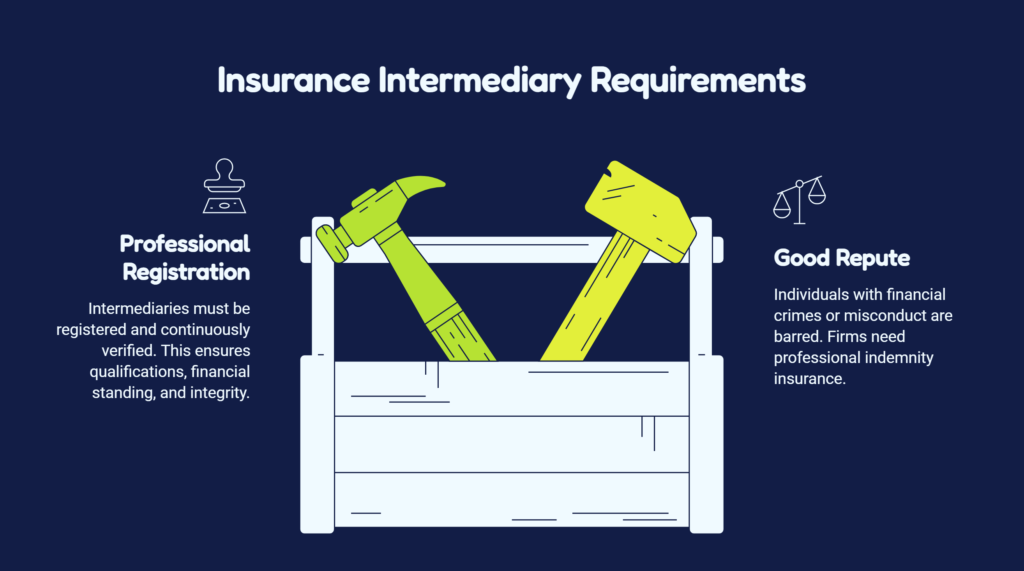
Under the strict guidelines of the directive, anyone acting as an insurance intermediary must be formally registered with the competent authority in their home member state. Registration is not a one-time formality; it requires continuous verification of professional qualifications, financial standing, and operational integrity.
Good Repute and Compliance Standards
To protect the public from predatory practices, the directive introduced rigid compliance requirements centered around the concept of “good repute.” Individuals with a history of financial crimes, bankruptcy, or serious professional misconduct are barred from operating as intermediaries. Furthermore, firms must maintain professional indemnity insurance to cover potential liabilities arising from professional negligence.
The Market Impact of the IMD
Effect on Insurance Market Regulation
The introduction of a unified directive completely transformed how member states approached market oversight. It forced local regulators to align their national codes with broader European standards, leading to increased transparency and more rigorous enforcement mechanisms across the continent.
Influence on Consumer Protection in Insurance
Consumer protection was the absolute cornerstone of the directive. Intermediaries were required to provide clear, written explanations to clients detailing why a specific policy was being recommended. This pivot away from high-pressure sales tactics toward needs-based advising significantly reduced mis-selling scandals.
Role in Enhancing Cross-Border Insurance Services
By introducing a “single passport” system, the directive allowed registered brokers in one member state to easily offer their services in another without needing a entirely separate corporate setup. This cross-border freedom intensified market competition, driving down premium prices and giving consumers access to a much wider array of specialized coverage options.
Criticism and Challenges Faced by the Directive
Despite its successes, the framework faced significant criticism over time. Industry experts argued that its definition of “mediation” was too narrow, leaving direct insurance writers and web-based aggregators largely unregulated. Additionally, the uneven implementation of the rules across different countries created minor regulatory discrepancies, which ultimately accelerated the need for legislative reform.
Transitioning from IMD to the Insurance Distribution Directive (IDD)
Reasons for Replacing IMD with the IDD
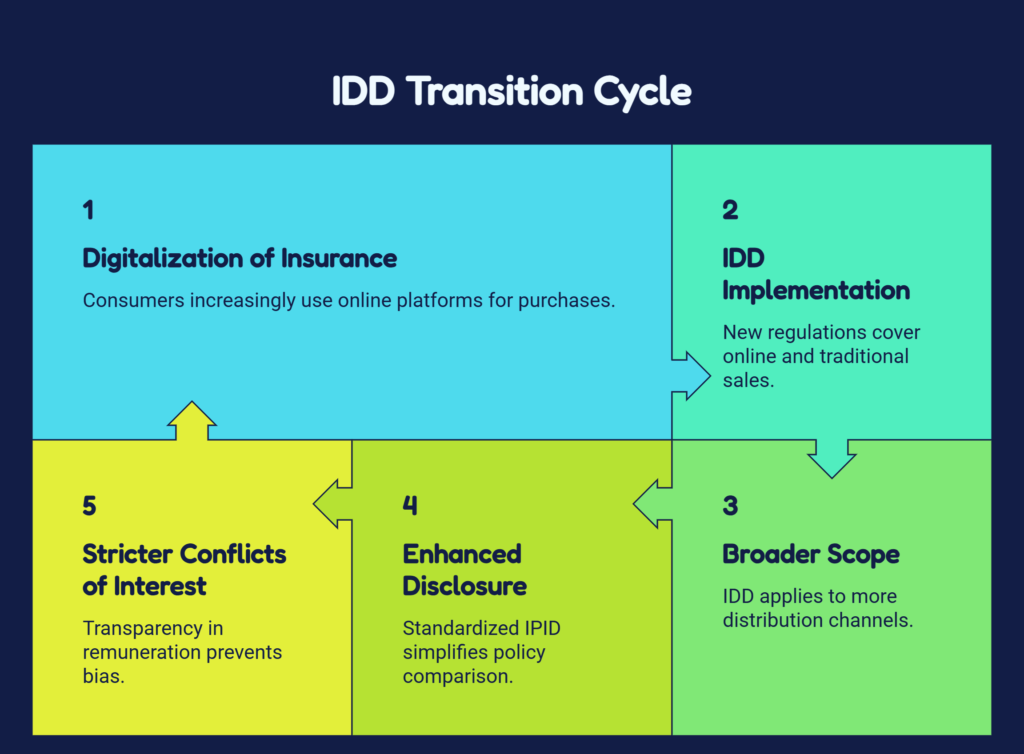
The primary catalyst for replacing the older framework was the rapid digitalization of the insurance market. Consumers were increasingly purchasing policies through online portals and aggregators rather than face-to-face meetings with brokers. The updated IDD was engineered to cover this entire ecosystem, ensuring that consumer protections remained identical whether an Insurance Mediation Directive policy was bought online or via a traditional agency.
Major Differences Between IMD and IDD
The transition introduced several critical upgrades to the regulatory landscape:
- Broader Scope: The IDD applies to insurance companies that sell directly to consumers, web-based price comparison platforms, and ancillary sellers (such as travel agents or car rental companies offering insurance).
- Enhanced Information Disclosure: Firms must now provide a standardized Insurance Product Information Document (IPID) to make comparing policies simple for everyday consumers.
- Stricter Rules on Conflicts of Interest: New mandates require complete transparency regarding how distributors are remunerated, preventing commission structures from influencing product recommendations.
Impact of the Transition on Stakeholders
For insurance brokers and agents, the shift meant a substantial overhaul of internal compliance systems. Administrative burdens increased, and sales workflows had to be redesigned to incorporate the mandatory disclosure documents. However, for consumers, the transition brought unparalleled clarity, making policy details, exclusions, and fee structures completely transparent.
Future of Insurance Regulation
The ongoing evolution of these directives signals a clear path forward: future regulatory updates will likely focus heavily on artificial intelligence integration, data privacy in underwriting, and sustainable insurance products.
Regional Implementations: UK, Ireland, and Beyond
Insurance Mediation Directive UK Application
A frequent question among global compliance officers is whether these standards still apply to the UK post-Brexit. The UK fully transposed the core principles of the directive into domestic law through the Financial Conduct Authority (FCA). The UK framework maintains identical, and in some cases stricter, consumer protection standards to ensure seamless alignment with international financial markets.
Insurance Distribution Directive Ireland Guidelines
Ireland implemented the directive via the European Union (Insurance Distribution) Regulations. The Central Bank of Ireland strictly enforces these rules, paying close attention to minimum competency codes and the structured ongoing training of insurance staff.
Understanding the Insurance Distribution Directive CPD Rules
Continuous Professional Development (CPD) is a mandatory requirement under modern distribution rules. Intermediaries must complete a minimum of 15 hours of structured professional training every year to maintain their regulatory compliance and keep their industry knowledge up to date.
For those looking to research the exact legal text and underlying European legislation, the official EUR-Lex Database provides full, unedited access to all historical and current directives.
Understanding General Mediation in the Insurance Industry
While the European directive governs the administrative and ethical rules of selling policies, the term “mediation” also refers to the practical process of resolving disputed claims between policyholders and carriers out of court.
Core Concepts of Dispute Mediation
When an Insurance Mediation Directive claim faces a standstill, formal dispute mediation serves as a faster, more cost-effective alternative to litigation. The process relies on specific structured frameworks to achieve neutrality and fairness:
- The 4 Types of Mediation: Disputes are generally handled through facilitative, evaluative, transformative, or narrative mediation styles, depending on the complexity of the case.
- The 7 Stages of Mediation: A standard mediation follows a clear sequence: the initial organizer introduction, opening statements from both sides, information gathering, problem identification, bargaining/negotiation, agreement drafting, and final resolution. (While sometimes condensed into 5 steps, the core trajectory remains identical).
- The 4 C’s of Mediation: Every successful resolution depends heavily on Comprehension, Compassion, Collaboration, and Compromise.
- The 7 Elements of Mediation: The entire process is built upon voluntary participation, absolute neutrality, strict confidentiality, self-determination, informed consent, complete impartiality, and good faith.
- The Golden Rule of Mediation: The presiding mediator must remain completely neutral at all times, guiding the conversation without ever imposing a personal decision or forced judgment on either party.
If you are navigating complex healthcare networks domestically and need a better understanding of how structured provider networks handle coverage boundaries, take a look at our detailed breakdown on What Is PHCS Insurance? Ultimate Guide to the PPO Network for clear insights.
FAQs
What is insurance mediation?
Insurance Mediation Directive involves the professional activity of introducing, proposing, or preparing insurance contracts, as well as assisting in the ongoing administration and management of those policies.
What directive does the new IDD replace?
The current Insurance Distribution Directive (IDD) officially replaced the older Insurance Mediation Directive (IMD) to create a safer, more unified playing field across modern digital and traditional insurance sales channels.
What is the IDD Directive?
The IDD is a comprehensive European Union regulation designed to regulate the way insurance products are designed, marketed, and sold to consumers, focusing heavily on transparency and preventing mis-selling.
What are the 7 rules of insurance?
The seven foundational principles that govern the insurance industry are utmost good faith, insurable interest, indemnity, subrogation, contribution, proximate cause, and loss minimization.
Does the UK follow IVDR?
No. The In Vitro Diagnostic Medical Devices Regulation (IVDR) is a highly specific European medical device framework. It is entirely unrelated to the financial services, consumer protection, or insurance distribution regulations discussed in this guide.
What is Directive 2011/61/EU?
Directive 2011/61/EU is the Alternative Investment Fund Managers Directive (AIFMD). It is a separate piece of European financial legislation targeting hedge funds and private equity, which compliance officers often cross-reference alongside insurance directives when auditing multi-asset financial portfolios.
Understanding broker regulations is just one part of building a solid commercial insurance strategy. See our Business Insurance Guide: Powerful Steps to Protect Your Assets for the complete picture on coverage types, costs, and choosing the right protection for your business.
Conclusion
The evolution from the original Insurance Mediation Directive to the modern IDD framework underscores a permanent shift toward complete consumer transparency and digital-first market regulation. By establishing rigorous rules for professional registration, continuous learning, and structured conflict resolution, these directives ensure that the global insurance ecosystem remains stable, competitive, and fair. Staying informed on these shifting compliance landscapes is the best way for modern professionals to protect their operations and build lasting authority with the consumers they serve.