Making Insurance Simple, One Insight at a Time.


Best Car Insurance Companies (2026): How to Compare and Choose
Compare the best car insurance companies in 2026 using market share, J.D. Power satisfaction results, NAIC complaint data, and AM Best ratings.
Quick Summary
Finding the right auto coverage requires understanding your unique driving needs, local state requirements, and the reputation of the carrier you choose. The best car insurance companies in 2026 balance affordable premiums with top-tier customer support and seamless claims processing. Insurance.com’s 2026 rate analysis, which uses Quadrant Information Services data, puts the national average for a full coverage policy at about $2,578 a year, or $215 a month.
Whether you are looking for the cheapest coverage, trying to decide between a $500 or $1000 deductible, or researching highly trusted names on forums like Reddit, exploring multiple quotes is essential. This guide covers the top 10 auto insurance companies in the USA, breaks down complex coverage types, offers proven strategies to lower your costs, and explains how to navigate the claims process successfully.
Table of Contents
Table of Contents
1. Which Are the Best Car Insurance Companies in the USA?
How We Evaluate the Best Car Insurance Companies
Insuria Insights does not sell insurance or test policies ourselves, so this page does not rank companies with a score of our own. Instead we rely on four published sources: the NAIC’s market share report for size, J.D. Power’s annual studies for customer and claims satisfaction, the NAIC’s complaint data for how often customers file complaints with regulators, and AM Best for financial strength. Size shows who most drivers buy from, satisfaction studies show how customers rate the experience, complaint data shows problems that reached regulators, and financial strength ratings show whether an insurer can pay claims.
No single source tells the whole story, which is why we recommend using all four before you buy. A large insurer can have average satisfaction, and a small regional carrier can lead a satisfaction study but not sell in your state. Rankings also change every year, so use the figures below as a starting point and confirm current results with each source.
The Industry Giants: Establishing the Baseline
By private passenger auto market share, the NAIC’s 2025 market share report (which uses 2024 data) lists State Farm first with 18.87%, followed by Progressive with 16.73%, the Berkshire Hathaway group that includes GEICO with 11.63%, Allstate with 10.19%, and USAA with 6.17%. Farmers, Liberty Mutual, Travelers, Auto Club Enterprises, and American Family complete the top ten. The table below shows the full list. Size is not the same as quality, but it does show which insurers most drivers choose.
| Rank | Insurer group | Market share |
|---|---|---|
| 1 | State Farm | 18.87% |
| 2 | Progressive | 16.73% |
| 3 | Berkshire Hathaway Group (GEICO) | 11.63% |
| 4 | Allstate | 10.19% |
| 5 | USAA | 6.17% |
| 6 | Farmers | 3.76% |
| 7 | Liberty Mutual | 3.27% |
| 8 | Travelers | 2.00% |
| 9 | Auto Club Enterprises (AAA) | 1.80% |
| 10 | American Family | 1.72% |
Source: NAIC 2025 Market Share Report (2024 data), as reported by industry trade publications.
Regional Carriers and Customer Satisfaction Leaders
Customer satisfaction tells a different story from market share. J.D. Power’s 2025 U.S. Insurance Shopping Study ranked Erie Insurance first among auto insurers, followed by Auto Club Group and State Farm. In its 2025 U.S. Auto Claims Satisfaction Study, based on 9,455 customers who settled a claim between September 2024 and August 2025, Erie scored 743 out of 1,000, ahead of NJM Insurance at 731 and Liberty Mutual at 730. The study measures trust, fairness of settlement, time to settle, communication, and ease of the claims process, among other factors.
| Study | 1st | 2nd | 3rd |
|---|---|---|---|
| 2025 U.S. Insurance Shopping Study (auto) | Erie Insurance | Auto Club Group | State Farm |
| 2025 U.S. Auto Claims Satisfaction Study (score out of 1,000) | Erie Insurance (743) | NJM Insurance (731) | Liberty Mutual (730) |
Source: J.D. Power. Claims study based on 9,455 customers who settled a claim between September 2024 and August 2025.
Insurers That Serve Specific Groups
Some insurers serve specific groups. USAA, for example, sells to military members, veterans, and eligible family members, so it is not an option for everyone even though it ranks among the largest auto insurers by market share. Check eligibility before you plan around any group-based insurer.
Ultimately, the best car insurance company for you will depend on your driving history, your financial situation, and what you prioritize most, such as price, customer service, or digital tools. J.D. Power’s 2026 U.S. Auto Insurance Study reported overall customer satisfaction unchanged at 644 out of 1,000, with seamless service across channels the biggest drag on scores.
2. Best Car Insurance Companies by State
Because insurance is regulated at the state level, the company that provides the cheapest car insurance in one location might be the most expensive in another. Average costs vary widely. Insurance.com’s 2026 analysis puts the average cost of full coverage at $1,660 a year in Vermont, the cheapest state, and $3,999 a year in Louisiana, the most expensive. It is vital to look at the best car insurance companies in the USA through a regional lens.
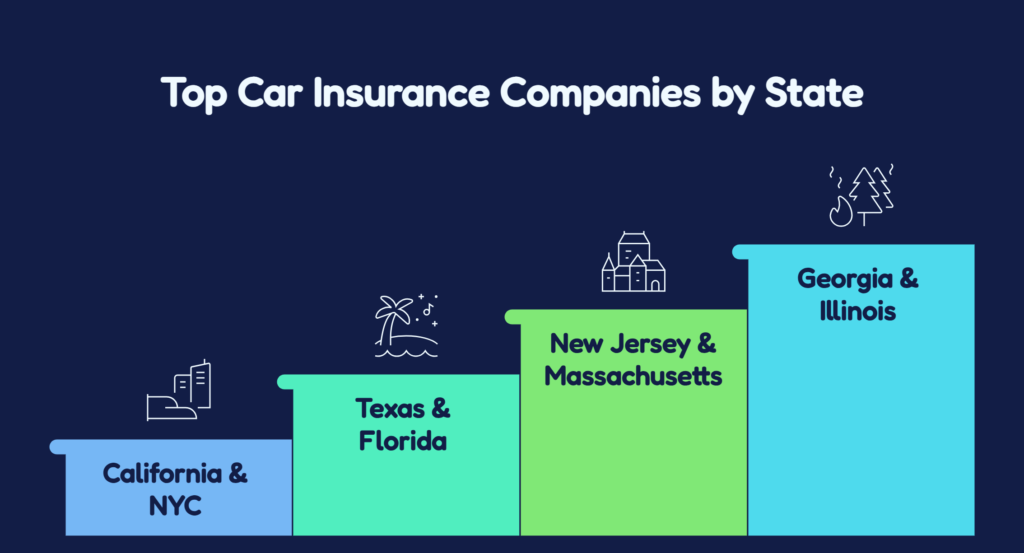
California and New York City:
High traffic density and strict state laws mean that drivers in California and NYC often face higher premiums. Carriers with strong local agent networks tend to perform best here.
Texas and Florida:
Drivers in Texas and Florida often deal with extreme weather events, making comprehensive coverage crucial. Top-rated regional carriers frequently compete with the major national brands to offer competitive rates.
New Jersey and Massachusetts:
These states have unique auto insurance regulations. NJ drivers, for instance, must navigate distinct no-fault rules, so a regional carrier can be worth a quote. NJM Insurance, a New Jersey-based insurer, placed second in J.D. Power’s 2025 claims study.
Georgia and Illinois:
Drivers in Georgia and Illinois often benefit from companies offering robust bundling options and safe driving discounts.
No matter where you live, check each insurer’s complaint record with the NAIC’s Consumer Insurance Search, where a complaint index of 1.0 is the average for a company of similar size, and look up its financial strength rating with AM Best before you buy. AM Best rates insurers from A++ (Superior) down, and ratings of B and below are described as vulnerable to adverse changes.
3. Understanding Car Insurance Policies and Coverage Types
The role of car insurance companies in protecting your finances cannot be overstated. However, you need to know exactly what you are buying. Understanding car insurance premiums and deductibles is the foundation of a solid policy.
One of the most common questions is whether it is better to have a $500 deductible or a $1000 deductible. A lower deductible means you pay less out of pocket after an accident, but your monthly premium will be higher.
The national average for full coverage is about $215 a month, and the deductible you choose is one of the biggest ways to move that number up or down. Conversely, a $1000 deductible lowers your premium but requires more cash upfront if you file a claim. You must also decide whether to pay your premium monthly or annually. Paying annually often unlocks a pay-in-full discount, while monthly payments provide better cash flow flexibility.
It is also important to understand the different types of coverage explained in your policy documents:
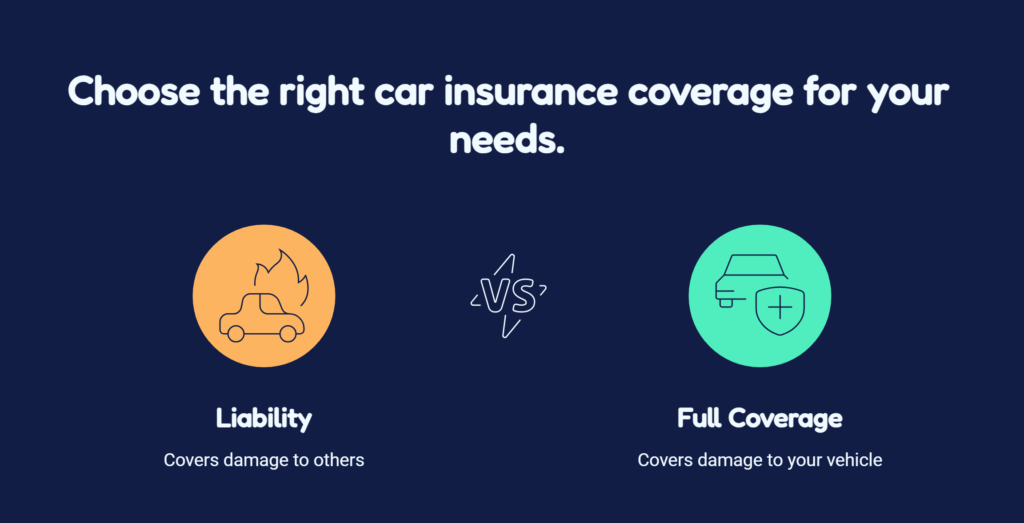
Liability vs. Full Coverage:
What is the difference? Liability only pays for the damage you cause to others. Full coverage includes both collision and comprehensive insurance to protect your own vehicle.
What is Comprehensive Car Insurance?
This covers non-collision events like theft, vandalism, falling objects, and extreme weather damage.
Customizing Your Policy:
You can tailor your coverage by adding roadside assistance, rental car reimbursement, or gap insurance based on your specific daily driving habits.
4. How to Save Money on Car Insurance
Balancing Cost and Quality
Finding affordable coverage does not mean you have to sacrifice quality. There are several ways to lower your costs without dropping important coverages.
The Impact of Safe Driving and Telematics
First, consider the impact of your driving record on insurance rates. Maintaining a clean record free of tickets and accidents is the most effective way to secure the cheapest car insurance. You can also look into using telematics to reduce car insurance premiums. These usage-based programs track your driving habits, like braking and accelerating, and reward safe drivers with significant price cuts. J.D. Power’s 2026 U.S. Auto Insurance Study ranked Nationwide first in the usage-based insurance category for the third year in a row.
Maximizing Discounts and Bundling Options
Additionally, always look for discounts you might be missing on your car insurance. Good student discounts, multi-vehicle savings, and anti-theft device incentives can add up quickly. How bundling auto and home insurance can save you money is another crucial factor. By combining policies under one provider, you unlock multi-line discounts. If you rent your home, bundling is just as effective. You can learn more about maximizing these specific regional benefits by reading our detailed guides on Renters Insurance Georgia (2026): Coverage, Costs & Savings Tips and Renters Insurance Ohio (2026): Coverage, Costs & Savings Tips.
5. Navigating Car Insurance Claims and Support
A policy is only as good as the company backing it when things go wrong. If you are searching for the best car insurance companies for claims, you need to look at industry ratings and real customer feedback.
Comparing customer satisfaction across best car insurance companies reveals that strong communication and speed are the top priorities for drivers. High-value customers now demand more from insurers, heavily factoring in claims experiences and digital tools when deciding whether to renew.
Understanding the claims process for car insurance will remove the stress from an already difficult situation. Here is what to do after a car accident:
- Ensure Safety First: Move to a safe location and check for injuries.
- Document the Scene: Take photos of all vehicles, road conditions, and license plates.
- Exchange Information: Get the other driver’s details and the contact info of any witnesses.
- File Promptly: Contact your insurer immediately to learn how to file a car insurance claim successfully.
It is also helpful to know tips for working with car insurance adjusters. Be honest, provide clear documentation, and never admit fault at the scene. Finally, be aware of common reasons car insurance claims get denied, such as driving for a rideshare service without the proper commercial endorsement or letting an unlisted driver use your vehicle.
6. Frequently Asked Questions (FAQs)
What are the top 5 car insurance companies?
By 2024 private passenger auto market share, the NAIC lists State Farm, Progressive, the Berkshire Hathaway group that includes GEICO, Allstate, and USAA as the five largest. Customer satisfaction rankings differ: J.D. Power’s 2025 claims study put Erie Insurance first, ahead of NJM Insurance and Liberty Mutual.
Which car insurance company is best in 2026?
There is no single best company for everyone. The best choice depends on your age, location, and vehicle. For example, the best car insurance companies for seniors might prioritize low-mileage discounts, while a younger driver might prioritize telematics programs.
Who is the most trusted car insurance company?
There is no single official trust ranking. J.D. Power’s 2025 Auto Claims Satisfaction Study, which measures trust as one of its factors, ranked Erie Insurance first at 743 out of 1,000, followed by NJM Insurance and Liberty Mutual. Check the NAIC complaint index and AM Best rating for any insurer you are considering.
How do I know which car insurance company to avoid?
No insurer is wrong for every driver, so check each company yourself. Look for a high number of complaints relative to its size in the NAIC’s Consumer Insurance Search, a weak AM Best financial strength rating, and a pattern of claims complaints in your state. Compare at least three insurers before you decide.
What is the average cost of full coverage car insurance?
Insurance.com’s 2026 analysis, based on Quadrant Information Services data, puts the national average for full coverage at $2,578 a year, or about $215 a month. Your own rate depends on your state, age, driving record, vehicle, and coverage choices.
What is the average cost of full coverage car insurance?
In 2026, the national average for a full coverage policy is roughly $2,578 per year, or about $215 per month. State minimum coverage averages $738 annually.
Is a $500 or $1000 deductible better?
A $1000 deductible is better if you want a lower monthly premium and can afford the $1000 out-of-pocket expense in the event of an accident. A $500 deductible is better if you prefer to minimize unexpected out-of-pocket costs, even if it means paying slightly more each month.
Is it cheaper to pay car insurance monthly or annually?
Paying annually is often cheaper, because many insurers offer a paid-in-full discount and some charge installment fees. Ask each insurer for both prices before you choose.
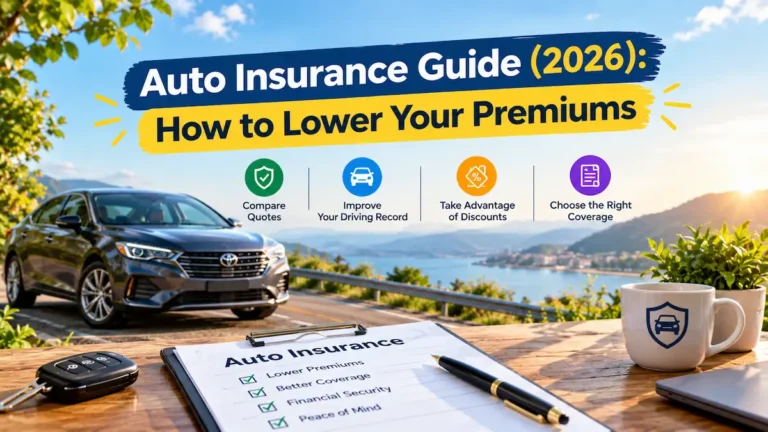
Comparing companies is only half the battle, knowing what providers don’t tell you matters just as much. Our Auto Insurance Guide: How to Lower Your Premiums covers the tactics and terms every driver should understand before signing up
7. Conclusion
Choosing the right auto coverage requires a bit of research, but the financial peace of mind is entirely worth the effort. By comparing the top 10 best car insurance companies, utilizing discounts, and understanding exactly what your policy covers, you can secure robust protection at a fair price. Remember to review your coverage annually, explore your state-specific options, and prioritize carriers with a proven track record of excellent claims support.
Disclaimer: This information is provided for general educational purposes only and does not constitute professional insurance, legal, or financial advice. Insuria Insights does not sell insurance. Rankings, rates, and company details come from third-party studies and change over time. Always compare quotes and confirm details with a licensed insurance professional before making coverage decisions.