Making Insurance Simple, One Insight at a Time.

Renters Insurance Georgia (2026): Coverage, Costs & Savings Tips
Renters insurance Georgia costs about $21 a month on average. See city rates, what it covers, which insurers are cheapest, and how to save.
Quick Summary
Renters insurance Georgia tenants buy costs about $250 a year, or roughly $21 a month, according to NerdWallet’s 2026 rate analysis, which is about 52% above the national average of $165. The price depends on where you live, how much you own, and your credit. Atlanta averages $296 a year, while smaller cities such as Athens average $232. A policy covers your belongings, your liability if someone is hurt in your unit, and hotel costs if you cannot live there after a covered loss. It does not cover flood damage. This renters insurance Georgia guide covers cost by city and by coverage limit, how much coverage to buy, and how to compare insurers and save.
Table of Contents
Table of Contents
- How Renters Insurance Georgia Policies Work
- How Much Does Renters Insurance Georgia Cost?
- How Much Coverage Do You Need in Georgia?
- How to Compare Renters Insurance Georgia Providers
- How to File a Renters Insurance Claim in Georgia
- Ways to Save on Renters Insurance in Georgia
- Frequently Asked Questions
- Conclusion
1. How Renters Insurance Georgia Policies Work
Renters insurance Georgia tenants buy is a policy that protects what you own and what you owe, not the building. You pay a monthly or annual premium. If a covered event happens, such as a fire or a break-in, you file a claim, pay your deductible, and the insurer pays the rest up to your limits.
What a Policy Covers
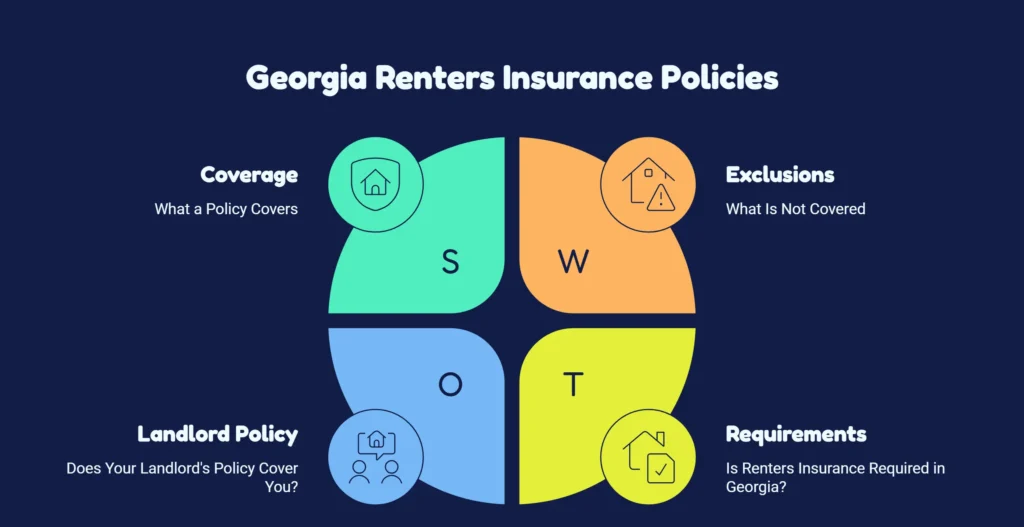
A standard policy has four main parts. Personal property coverage pays to repair or replace belongings such as furniture, clothing, and electronics. Liability coverage helps pay legal costs and damages if someone is injured in your unit or you accidentally damage someone else’s property. Additional living expenses coverage pays for a hotel and extra costs if a covered loss makes your home unlivable. Medical payments coverage pays small medical bills for a guest hurt at your home regardless of fault. In a 2023 release, Georgia’s Insurance Commissioner said that cell phones, computers, televisions, furniture, and clothing are covered by most policies.
Does Your Landlord’s Policy Cover You?
No. The Georgia Department of Community Affairs’ Landlord-Tenant Handbook says a landlord’s property insurance typically does not cover a tenant’s personal items, and the Commissioner’s own office says those policies “almost never” do. The Insurance Commissioner’s renters insurance guidance makes the same point and recommends tenants protect their belongings with their own policy.
Is Renters Insurance Required in Georgia?
No Georgia law requires it, according to NerdWallet, but the state’s Landlord-Tenant Handbook notes that some leases require tenants to buy it. Check your lease for the required liability limit before you request renters insurance Georgia quotes, and ask for proof of coverage to send to your property manager.
What Is Not Covered
Most renters policies do not pay for flood damage, earthquakes, or damage you cause on purpose. FEMA’s Floodsmart program says flood damage is often excluded from standard renters policies and that renters can buy separate National Flood Insurance Program coverage for their belongings. Pest infestations are generally treated as maintenance problems, so check your policy wording.
2. How Much Does Renters Insurance Georgia Cost?
NerdWallet’s 2026 analysis puts the average renters insurance Georgia premium at $250 a year, or about $21 a month, about 52% above the national average. Its sample renter has good credit, no recent claims, a two-bedroom apartment, $30,000 of personal property coverage, $100,000 of liability, and a $500 deductible. An older figure cited by the Georgia Commissioner’s office from the Insurance Information Institute was $212 a year in 2023, though the two figures use different methods and are not directly comparable.
| City | Average per year | Average per month |
|---|---|---|
| Atlanta | $296 | $25 |
| Columbus | $275 | $23 |
| Decatur | $275 | $23 |
| Macon | $275 | $23 |
| Savannah | $255 | $21 |
| Augusta | $249 | $21 |
| Valdosta | $249 | $21 |
| Athens | $232 | $19 |
| Alpharetta | $231 | $19 |
| Cumming | $215 | $18 |
| Georgia statewide | $250 | $21 |
Source: NerdWallet, “The Best and Cheapest Renters Insurance in Georgia,” updated September 2026, with sample rates from Quadrant Information Services. Sample renter has good credit, no recent claims, $30,000 of personal property coverage, $100,000 of liability, and a $500 deductible. Your own quote will differ.
Why Cost Varies by City
The renters insurance Georgia cost spread across cities is wide. Atlanta averages $296 a year and Lithonia $318, while Cumming averages $215. The data does not support the idea that coastal cities always pay more: Savannah, at $255, sits below Atlanta. Local theft and claim rates, building age, and the insurer’s own pricing models all feed into the number.
Credit and Price
Many Georgia insurers use credit-based insurance scores to set rates. NerdWallet says renters with poor credit pay an average of $410 a year, which is 64% more than renters with good credit. Improving your credit before renewal can lower the renters insurance Georgia premium you are quoted.
The Cheapest Companies in the Data
At the $30,000 personal property level, NerdWallet’s average annual rates were State Farm $165, Auto-Owners $190, Travelers $200, Progressive $235, Cincinnati Insurance $240, and Grange $240. USAA averaged $205 but is limited to military members, veterans, and some families. These are averages for a sample renter, so your own quote can differ. An insurer with a low average is not necessarily the best fit, so compare service and claims reputation as well as price.
3. How Much Coverage Do You Need in Georgia?
NerdWallet advises buying enough personal property coverage to replace everything you own, and it suggests using a home inventory app to estimate what your belongings are worth. The table below shows what each step up in renters insurance Georgia coverage costs on average, which makes the decision easier.
| Personal property limit | Statewide average | State Farm | Auto-Owners | Travelers |
|---|---|---|---|---|
| $10,000 | $170 | $115 | $140 | $155 |
| $30,000 | $250 | $165 | $190 | $200 |
| $50,000 | $355 | $215 | $245 | $270 |
| $70,000 | $470 | $260 | $300 | $340 |
| $100,000 | $625 | $320 | $385 | $405 |
Source: NerdWallet, “The Best and Cheapest Renters Insurance in Georgia,” updated September 2026. Annual averages for a sample renter with good credit, no recent claims, $100,000 of liability, and a $500 deductible. Rates are averages, not quotes, and listing a company is not an endorsement.
Is $15,000 Enough?
It depends on what you own. A $15,000 limit is not in the table, but going from $10,000 to $30,000 of coverage adds about 80ayeartotheaveragerentersinsuranceGeorgiapremium(170 versus $250). Add up your electronics, furniture, clothing, and kitchen items before you decide, because many people own more than they expect. If your total is near or above $15,000, the extra cost for the next tier is small compared with an uncovered loss.
Liability and Other Limits
NerdWallet’s sample policy carries $100,000 of liability, $10,000 of additional living expenses, and $1,000 of medical payments. NerdWallet recommends enough liability coverage to protect assets such as a car, savings, and investments. Some insurers sell higher liability limits, and your lease may set a minimum.
Replacement Cost vs Actual Cash Value
Ask whether the policy pays replacement cost, which covers the price of a new item, or actual cash value, which subtracts depreciation. Replacement cost usually costs a bit more but pays more after a loss.
Georgia Weather and Flood Risks
Wind damage is usually covered by renters insurance Georgia policies, but NerdWallet notes coastal policies may carry a separate, higher windstorm deductible. In high-risk coastal areas a policy might exclude wind entirely, and the Georgia Underwriting Association, the state’s insurer of last resort, is an option. Because flood damage is typically excluded, ground-floor tenants in at-risk areas may want separate flood coverage.
4. How to Compare Renters Insurance Georgia Providers
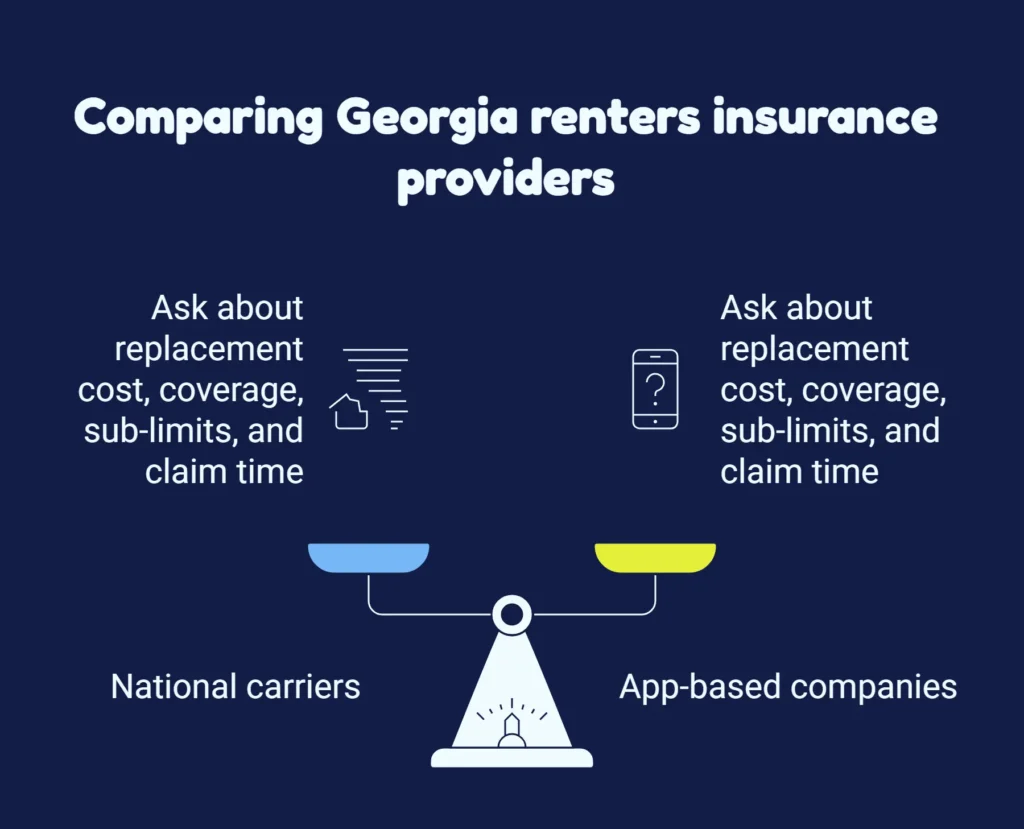
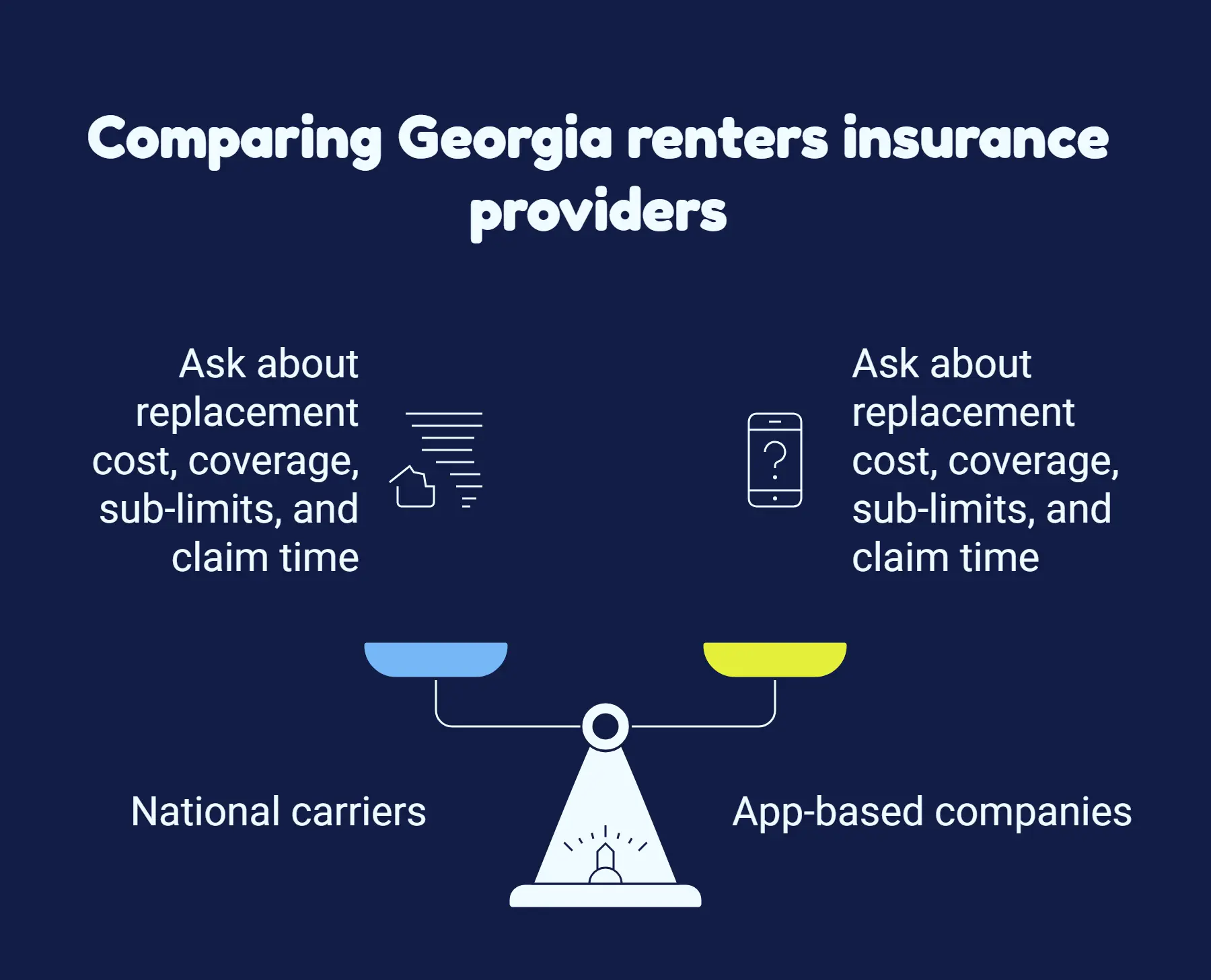
Request at least three renters insurance Georgia quotes, using the same personal property limit, liability limit, and deductible each time so the prices are comparable. Larger national carriers, regional insurers, and app-based companies all sell renters insurance Georgia policies. Ask each one the same questions: whether the policy pays replacement cost, whether it covers items in storage or in a car, whether there are sub-limits on jewellery or electronics, and how long a claim typically takes.
Check the Insurer
Confirm the company is licensed before you buy. The Georgia Insurance Commissioner’s office handles consumer questions through its Consumer Services Division, which a 2023 release lists at 1-800-656-2298. Check the office’s website for current contact details. You can also look up a company’s complaint history through the NAIC’s consumer search before you decide.
5. How to File a Renters Insurance Claim in Georgia
Filing a renters insurance Georgia claim starts with safety, so make sure everyone is safe first. If a crime occurred, call the police and ask for a report. Photograph or video the damage, then report the loss to your insurer and keep copies of everything you send.
Documents You May Need
Insurers typically ask for a completed claim form, a police report for theft or vandalism, photos, and receipts or other proof of ownership. A home inventory with photos, serial numbers, and receipts, kept in the cloud, makes a claim easier to document.
Why Claims Get Denied or Reduced
Common reasons include a loss that falls under an exclusion, such as flood, missed reporting deadlines, and not enough proof of ownership. Claims history can also affect your rates and renewal terms, depending on the insurer, so ask how a claim would affect your policy before you decide whether to file a small one.
6. Ways to Save on Renters Insurance in Georgia
To lower your renters insurance Georgia premium, start with the biggest factors. A higher deductible lowers the premium, but make sure you could afford to pay it after a loss. Credit matters too, as covered above. Choose limits that match your belongings instead of buying more than you need.
Bundling and Discounts
Many insurers discount renters policies when you bundle them with auto coverage, and some offer small credits for paperless billing, autopay, or safety devices such as smoke detectors and deadbolts. Discounts vary by company, so ask each one what applies. Before you bundle, compare the auto price on its own, and see our Auto Insurance Guide (2026): How to Lower Your Premiums for ways to cut that bill.
Review Each Year
Rates change, so get fresh renters insurance Georgia quotes at renewal, and update your address and coverage when you move. Your premium can shift with your new ZIP code. For a wider look at how renters coverage fits with other home protection, see our Ultimate 2026 Home Insurance Guide: Best Protection Tips.
7. Frequently Asked Questions
How much is renters insurance in Georgia?
NerdWallet’s 2026 analysis puts the average at $250 a year, about $21 a month, for a sample renter with $30,000 of personal property coverage. Atlanta averages $296 a year.
Is renters insurance mandatory in Georgia?
No state law requires it, but some leases do, according to the Georgia Department of Community Affairs’ Landlord-Tenant Handbook. Check your lease.
What does renters insurance Georgia coverage include?
It covers your belongings, personal liability, additional living expenses after a covered loss, and small medical payments for guests. It does not cover flood damage.
Who has the cheapest renters insurance in Georgia?
At $30,000 of personal property coverage, NerdWallet’s lowest averages were State Farm at $165 a year, Auto-Owners at $190, and Travelers at $200. Your quote depends on your ZIP code, credit, and coverage choices.
Is $15,000 enough renters insurance?
Only if your belongings are worth less than that. Make a room-by-room inventory first. The statewide average moves from $170 to $250 a year when you go from $10,000 to $30,000 of coverage.
How much does $100,000 of personal property coverage cost?
The 2026 statewide average is $625 a year, about $52 a month. A $100,000 liability limit is a different thing, and it is part of the standard sample policy that produces the $21 average.
What are the two types of insurance Georgia requires?
For drivers, Georgia requires liability coverage for bodily injury and property damage, with basic limits of 25/50/25 according to the Insurance Commissioner’s auto guide. Renters insurance is not required by law.
What is not covered by renters insurance?
Flood and earthquake damage and intentional damage are typically excluded. Check your policy for pests and for sub-limits on valuables such as jewellery.
Can roommates share a renters policy?
Some insurers allow it, but a shared policy has one set of limits, and a claim can get complicated if a roommate moves out. Separate policies are often simpler. Ask your insurer about named insureds and limits.
What is the difference between a deductible and a limit?
A deductible is what you pay before the insurer pays. A limit is the most the insurer will pay for a covered loss. A higher deductible lowers your premium, and higher limits raise it.
8. Conclusion
Renters insurance Georgia tenants carry is inexpensive compared with the cost of replacing everything you own, averaging about $21 a month statewide, though Atlanta runs higher. Take an inventory, choose limits that match it, and compare at least three quotes with identical coverage. Check your lease for requirements, add flood coverage if your unit is at risk, and review your renters insurance Georgia policy each year.
Disclaimer: This information is provided for general educational purposes only and does not constitute professional insurance, legal, or financial advice. Premiums, coverage terms, and availability vary by insurer, location, and individual circumstances and change over time. Always confirm details with a licensed insurance professional before buying a policy.