Making Insurance Simple, One Insight at a Time.


Renters Insurance Ohio (2026): Coverage, Costs & Savings Tips
Renters insurance Ohio costs about $12 to $20 a month, depending on coverage. See city rates, what is covered, cheap insurers, and ways to save.
Quick Summary
Renters insurance Ohio tenants buy costs about $12 to $20 a month, depending on which 2026 rate study you read and how much coverage it assumes. NerdWallet’s statewide average is $145 a year, MoneyGeek’s is $192, and Insurance.com’s is $234. A policy covers your belongings, your liability if a guest is hurt, and hotel and meal costs if a covered loss makes your home unlivable. It does not cover flood damage, and Ohio law does not require it, though many landlords do. This renters insurance Ohio guide explains why the averages differ, what a policy covers, how much coverage to buy, and how to compare insurers and lower your premium.
Table of Contents
Table of Contents
1. How Renters Insurance Ohio Policies Work
Renters insurance Ohio tenants carry protects what you own and what you owe, not the building. You pay a premium, and if a covered event happens, you file a claim, pay your deductible, and the insurer pays the rest up to your policy limits.
What a Policy Covers
The Ohio Department of Insurance explains that renters insurance covers your personal property against named perils, with fire, windstorm, hail, and theft among the common ones. Payouts are capped by the personal property limit you choose, and sublimits may apply to items such as cash, jewelry, firearms, watercraft, and business property. Liability coverage applies when someone claims you caused injury or property damage through negligence.
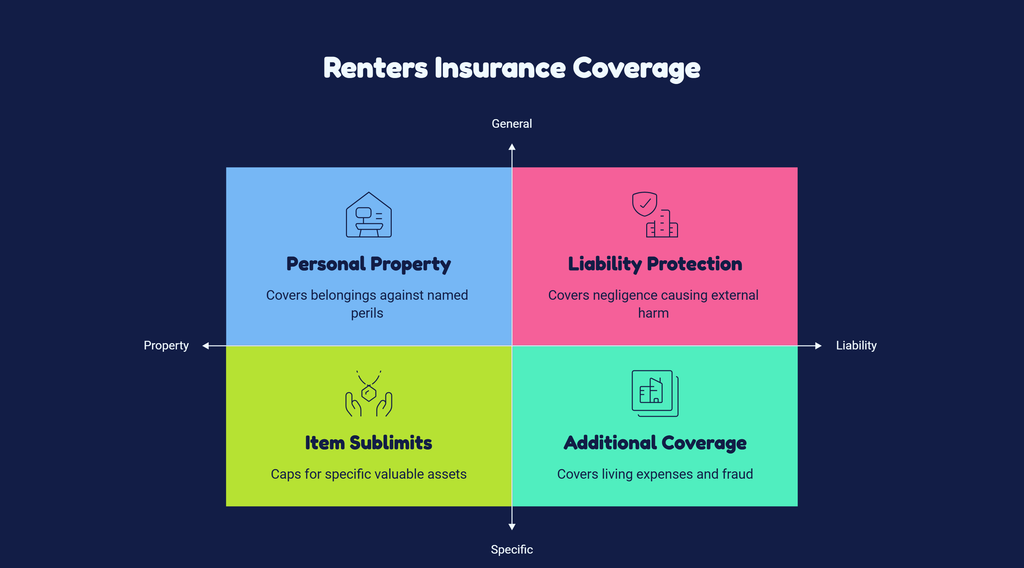
Medical payments coverage helps with injuries to people who are not members of your household. Loss of use coverage, often called additional living expenses, can pay for a hotel, meals, and other necessary costs while your home is repaired after a covered loss. The Department also notes that many Ohio policies reimburse unauthorized charges from credit or debit card theft, forgery, and counterfeit money.
Your Landlord’s Policy Does Not Cover Your Belongings
The Department’s Insurance for Renters guide says the owner’s insurance typically only covers the building itself, not the renter’s personal belongings. That is the gap renters insurance fills.
Is Renters Insurance Required in Ohio?
No. The Ohio Department of Insurance states that renters insurance is not mandated by Ohio law, but landlords often require it in the lease, so review your lease terms before signing. If your lease sets a minimum liability limit, make sure every renters insurance Ohio quote you request meets it.
What Is Not Covered
Policies generally exclude earthquakes, floods, normal wear and tear, and war, according to the Department. They also exclude vehicles, business data, and property owned by unrelated roommates. FEMA’s Floodsmart program says flood damage is often excluded from standard renters policies and that renters can buy separate National Flood Insurance Program coverage for their belongings, which matters if your unit is on a ground floor or near a river.
2. How Much Does Renters Insurance Ohio Cost?
Published averages for renters insurance Ohio residents pay range from $145 to $234 a year, and two of the three sources put Ohio below their national averages. The spread comes from the coverage each study assumes, not from errors: a higher personal property limit or a larger deductible changes the price, and each source picks its own sample policy. NerdWallet’s national average is $165 a year and MoneyGeek’s is $196, so Ohio sits below both.
| Source | Average per year | Average per month | Sample coverage behind the number |
|---|---|---|---|
| NerdWallet | $145 | $12 | $30,000 personal property, $100,000 liability, $500 deductible, good credit |
| MoneyGeek | $192 | $16 | $20,000 personal property, $100,000 liability, $500 deductible |
| Insurance.com | $234 | $20 | $40,000 personal property, $100,000 liability, $1,000 deductible, good credit |
Sources: NerdWallet, “How Much Is Renters Insurance” (updated September 2026); MoneyGeek, “Best Cheap Renters Insurance in Ohio” (2026); Insurance.com, “Best Renters Insurance in Ohio” (updated February 2026). NerdWallet and Insurance.com use sample rates from Quadrant Information Services. Averages are not quotes; your price will differ.
If you saw $166 to $192 a year elsewhere, that range sits inside the table: the top of it matches MoneyGeek’s figure. Use the numbers as a budgeting range for renters insurance Ohio costs, then get quotes with your own coverage.
Cost by City
MoneyGeek’s Ohio city averages show how much location matters for renters insurance Ohio premiums. Toledo is the most expensive at $245 a year, well above the state average of $192. Cleveland averages $198, Dayton $196, Akron $194, Columbus $183, and Cincinnati $176. Insurance.com also found Toledo’s priciest ZIP code, 43601, at $297 a year in its sample, compared with $209 in Cincinnati’s cheapest ZIP code, 45245. Crime rates, weather risk, and claim history in your area all affect your renters insurance Ohio quote.
Which Insurers Price Low
Grange appears at or near the top of the cheapest lists in both Insurance.com and MoneyGeek, with State Farm also among the lower-priced options. MoneyGeek lists Grange at $110 a year and State Farm at $126, while Insurance.com lists Grange at $159 and State Farm at $178 because it uses a larger sample policy. USAA also appears near the top in MoneyGeek’s data but serves only military members, veterans, and their families. These are averages for sample renters, so your quote may be different, and the cheapest company is not always the best fit for service or claims handling.
3. How Much Coverage Do You Need in Ohio?
Insurance.com advises carrying enough personal property coverage to replace all your belongings at replacement cost. Start with a room-by-room inventory of furniture, clothing, electronics, and kitchen items, with estimated replacement values, then choose a limit that matches the total.
Is $15,000 Enough?
Only if your inventory comes in below it. The sample policies behind the figures above assume $20,000 to $40,000 of personal property coverage, so a $15,000 limit is lower than what these sources priced. Add up what you own before you choose, and ask for quotes at two or three limits so you can see how much each step up in renters insurance Ohio coverage costs.
Liability Limits
The sample policies assume $100,000 of liability. Insurance.com quotes insurance professional Josiah Hatch as saying that raising liability to $500,000 “costs next to nothing,” probably about $10 a year. Ask your insurer for the price of a higher renters insurance Ohio liability limit, since it protects your savings if you are sued after a guest is injured.
Replacement Cost vs Actual Cash Value
Replacement cost pays the price of a new item, while actual cash value subtracts depreciation. Ask which one your renters insurance Ohio policy uses for belongings, because it changes what you receive after a loss.
Valuables and Sublimits
Because renters insurance Ohio policies can cap payouts for jewelry, cash, and similar items, check the sublimits. If you own an engagement ring, a musical instrument, or other valuable pieces, ask about a scheduled personal property endorsement that insures them for their full value.
Ohio Weather
Windstorm and hail are among the common covered perils, so a severe storm that damages your belongings is typically covered. Flood is not, and water damage rules differ by policy, so read the wording on burst pipes, sewer backup, and rising water before you assume you are protected.
4. How to Compare and Buy Renters Insurance Ohio Policies
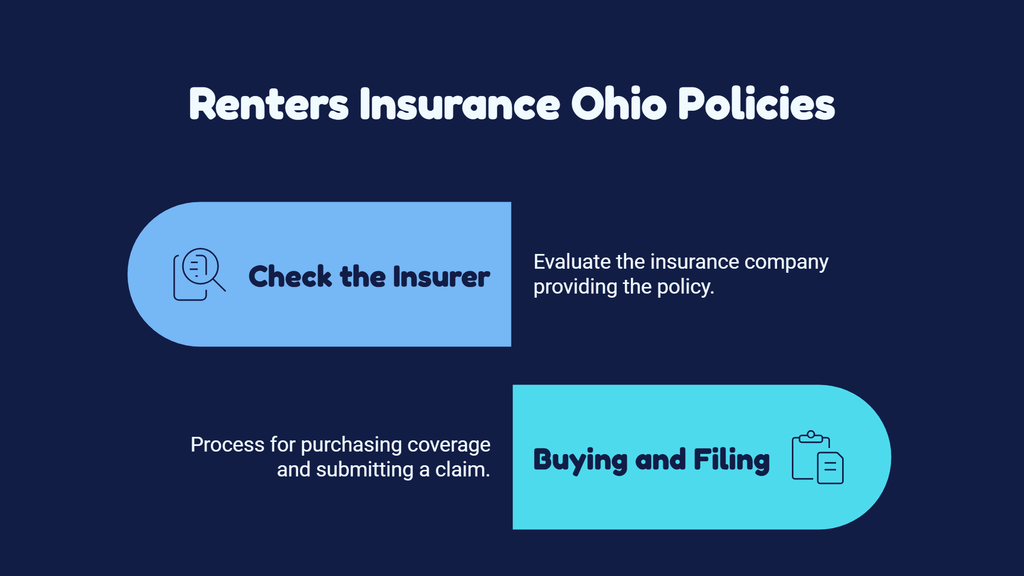
Request at least three quotes with the same personal property limit, liability limit, and deductible, so the prices compare fairly. National insurers, regional insurers, and app-based companies all sell renters insurance Ohio policies. Beyond price, ask whether the policy pays replacement cost, what the sublimits are, whether it covers items stored off site, and how claims are filed.
Check the Insurer
The Ohio Department of Insurance lets you check an insurer’s licensing and file a complaint. Its Consumer Services line, listed on its renters guide, is 800-686-1526, and you can confirm current contact details on its website. MoneyGeek also advises checking complaints filed with the Department before you choose.
Buying and Filing a Claim
Many insurers let you get quotes online and receive proof of coverage quickly, which helps if your landlord needs it before move-in. Confirm the effective date before you rely on it. If you need to file a claim, report the loss promptly, take photos, keep receipts, and make a police report for theft. A cloud-based home inventory makes the process easier. Read your declarations page when the policy arrives, since it lists your limits, deductible, and covered perils.
5. Ways to Save on Renters Insurance in Ohio
The most reliable renters insurance Ohio savings come from the levers you control. Raise your deductible if you can pay it from savings, choose limits that match your inventory instead of guessing high, and ask each insurer which discounts apply. Common ones include bundling, paperless billing, autopay, and safety devices such as deadbolts and smoke detectors, though availability varies.
Bundle Carefully
Bundling renters insurance Ohio coverage with auto insurance often earns a discount, but compare the auto price on its own first. Our Auto Insurance Guide (2026): How to Lower Your Premiums shows how to cut that bill, and our Ultimate 2026 Home Insurance Guide: Best Protection Tips explains how renters coverage fits with other home protection.
Compare States and Re-Shop Each Year
Renters insurance costs differ widely by state. NerdWallet’s 2026 averages are $145 a year in Ohio and $250 in Georgia, which you can explore in our Renters Insurance Georgia (2026): Coverage, Costs & Savings Tips guide if you are relocating. Whatever state you are in, get fresh renters insurance Ohio quotes at renewal and update your policy when you move.
6. Frequently Asked Questions
How much is renters insurance in Ohio?
It depends on the study: NerdWallet’s 2026 average is 145ayear(12 a month), MoneyGeek’s is 192(16 a month), and Insurance.com’s is 234(20 a month). Each uses a different sample policy.
Is renters insurance required in Ohio?
No. The Ohio Department of Insurance says Ohio law does not require it, but landlords often make it a lease condition.
Is it illegal to rent without renters insurance?
No. A landlord can require it in the lease, so check your lease before you move in.
Is $15,000 enough renters insurance?
Only if your belongings are worth less than that. Make an inventory first. The sample policies behind the published averages assume $20,000 to $40,000 of coverage.
Who has the cheapest renters insurance in Ohio?
Grange and State Farm appear near the top of the cheapest lists in both Insurance.com and MoneyGeek. USAA is also low but limited to military families. Your quote depends on your ZIP code and coverage.
What is not covered by renters insurance?
The Ohio Department of Insurance lists earthquakes, floods, normal wear and tear, and war, along with vehicles, business data, and property owned by unrelated roommates. Check your policy for pests and for intentional damage.
Does renters insurance cover my roommate’s belongings?
Property owned by unrelated roommates is generally excluded, according to the Department of Insurance, so each roommate usually needs their own policy.
How does renters insurance Ohio coverage work?
You pay a premium. If a covered event damages or destroys your belongings, you file a claim, pay your deductible, and the insurer pays up to your limit.
What does loss of use or additional living expenses cover?
It can pay for a hotel, meals, and other necessary costs while your home is repaired after a covered loss that makes it uninhabitable.
Is renters insurance Ohio coverage worth it?
For $12 to $20 a month, it protects your belongings and your finances from liability claims, which a landlord’s policy does not.
7. Conclusion
Renters insurance Ohio tenants buy is inexpensive compared with replacing a household of belongings, with published averages from about $12 to $20 a month. Count what you own, choose renters insurance Ohio limits to match, add flood coverage if your unit is at risk, and compare at least three quotes with identical terms. Check your lease for requirements, ask about discounts and sublimits, and re-shop each year.
Disclaimer: This information is provided for general educational purposes only and does not constitute professional insurance, legal, or financial advice. Premiums, coverage terms, and availability vary by insurer, location, and individual circumstances and change over time. Always confirm details with a licensed insurance professional before buying a policy.