Making Insurance Simple, One Insight at a Time.

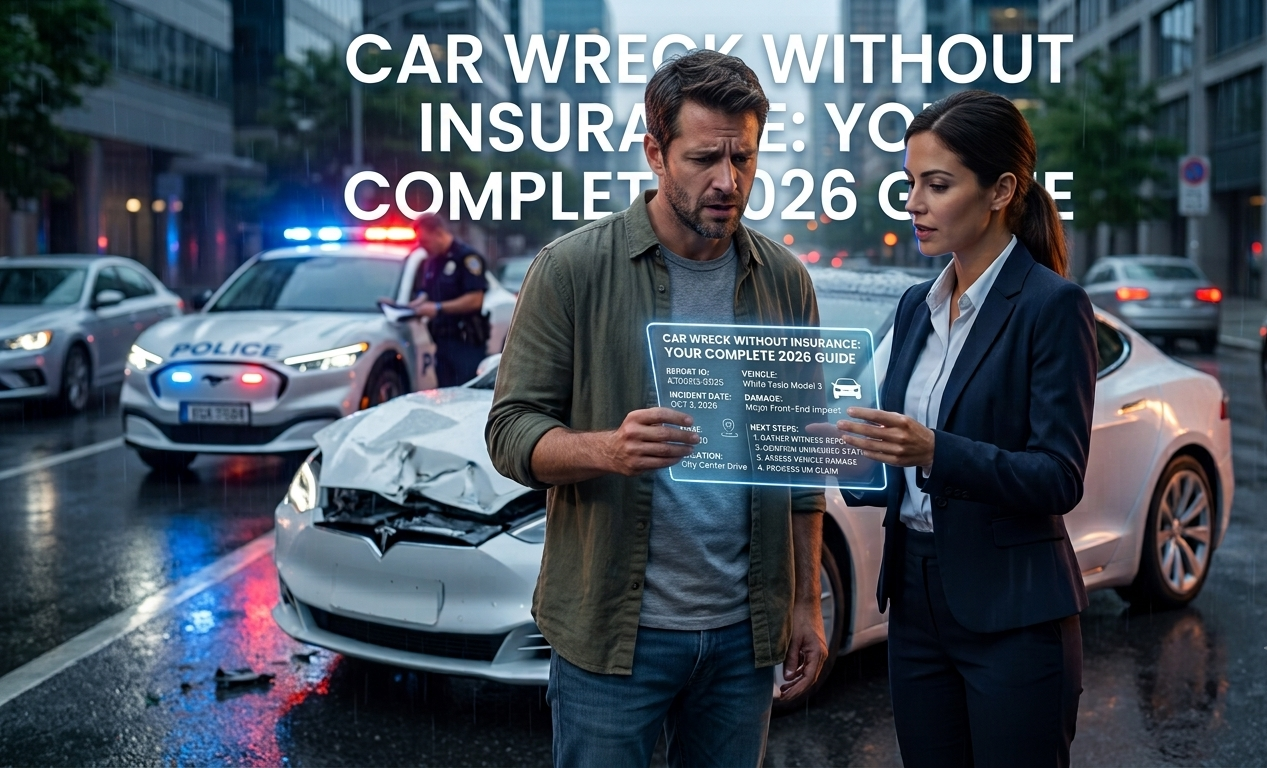
Car Wreck Without Insurance: Your Complete 2026 Guide
Had a car wreck without insurance? Discover your legal risks, how to handle out of pocket repair costs, and steps to secure coverage in our complete guide.
Quick Summary
Experiencing a car wreck without insurance can be a chaotic and overwhelming situation, regardless of whether you caused the collision or were an innocent bystander. This educational guide breaks down the immediate steps you should take at the scene, the legal and financial penalties of driving uninsured, and how to navigate out-of-pocket medical bills and auto repair costs. We explore how fault is determined, what happens if you face a lawsuit, and how to properly protect yourself moving forward. By understanding the core risks and recovery options, you can better navigate the complex logistical and legal steps that follow an uninsured auto accident.
Table of Contents
Table of Contents
1. Dealing with a Car Wreck Without Insurance
Being involved in a car wreck without insurance requires immediate, deliberate action to ensure your personal safety and preserve necessary information. Knowing the exact steps to take immediately after an accident can drastically alter the trajectory of your situation and protect your interests.
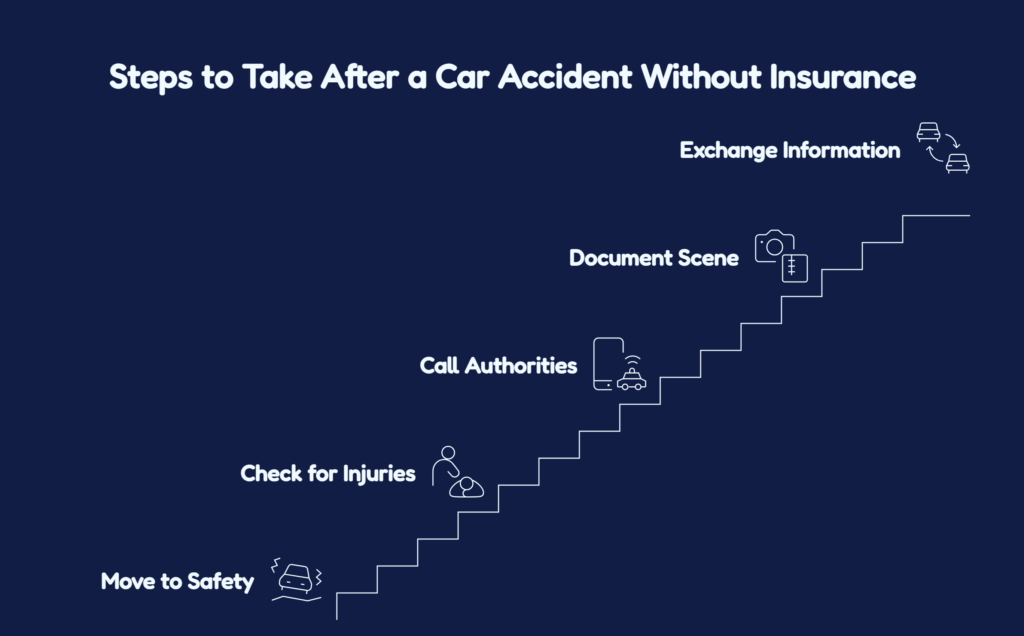
Steps to Take Immediately After an Accident
- Move to Safety: If possible, steer your vehicle to the side of the road and turn on your hazard lights.
- Check for Injuries: Check yourself, your passengers, and the other drivers for any immediate medical needs.
- Call the Authorities: Always contact law enforcement to dispatch an officer to the scene. A formal police report is a foundational piece of documentation, particularly when insurance coverages are absent or disputed.
- Document the Scene: Take comprehensive photographs of vehicle damage, license plates, road conditions, and any relevant street signs.
- Exchange Information: Share names, contact details, and driver’s license numbers with the other parties involved.
During these interactions, there is one crucial rule of thumb: why should you never admit fault? Admitting fault or even apologizing at the scene can be used against you legally during future liability assessments, even if subsequent evidence proves you were not the responsible party.
The Dynamics of Fault in Uninsured Wrecks
Drivers frequently search online to understand what happens in a car wreck without insurance when they are not at fault. If you are entirely driving without coverage but another insured driver hits you, the baseline liability often rests on the negligent driver’s policy. However, your right to recovery can be heavily limited depending on your local jurisdiction.
Conversely, looking up the realities of a car wreck without insurance at fault reveals a much more severe situation. If you lack insurance and cause a collision, you face immediate exposure to personal liability, vehicle impoundment, and severe administrative penalties.
2. Understanding the Risks of Driving Uninsured
Operating a motor vehicle without active insurance coverage carries immense financial and operational dangers. Every state or region establishes unique parameters around financial responsibility to safeguard road users.
Why Car Insurance is Mandatory
Car insurance acts as a societal safety net, ensuring that injured parties receive medical care and property restitution after an accident. When analyzing why car insurance is mandatory, it comes down to risk management: an individual driver rarely has the liquid assets required to pay for catastrophic medical injuries or total vehicle replacements out of pocket.
Fines versus Premium Costs
When comparing the costs of insurance vs. potential fines, skipping your insurance payments to save money is a massive mathematical risk. While a monthly policy premium is a predictable expense, the legal consequences of driving without insurance span far beyond a basic traffic ticket. You may face:
- Substantial court fines and administrative penalties.
- The immediate suspension of your driver’s license and vehicle registration.
- The mandatory requirement to file an SR-22 form, which labels you a high-risk driver and inflates future costs.
Local regulations vary significantly across different territories. For instance, motorists often question what the exact penalty is for driving with no insurance in Alabama, where a first-offense conviction can result in fines up to $500 and an immediate registration suspension. Other regions globally feature localized restrictions, with specific legal variations applied to drivers in the UK, New Zealand, and Ontario.
Uninsured Motorist Statistics and Coverage Roles
Uninsured motorist accident statistics indicate that a surprising percentage of drivers on the road operate completely uninsured or underinsured. To defend against this risk, insurance companies offer Uninsured Motorist (UM) coverage. If you hold a valid policy with UM coverage and are hit by an uninsured driver, your own carrier steps in to pay for your medical bills and property damage up to your specific policy limits.
3. Navigating Auto Repairs and Medical Costs Uninsured
When an uninsured vehicle is damaged or an uninsured individual is injured, the path to physical and mechanical recovery is complex.
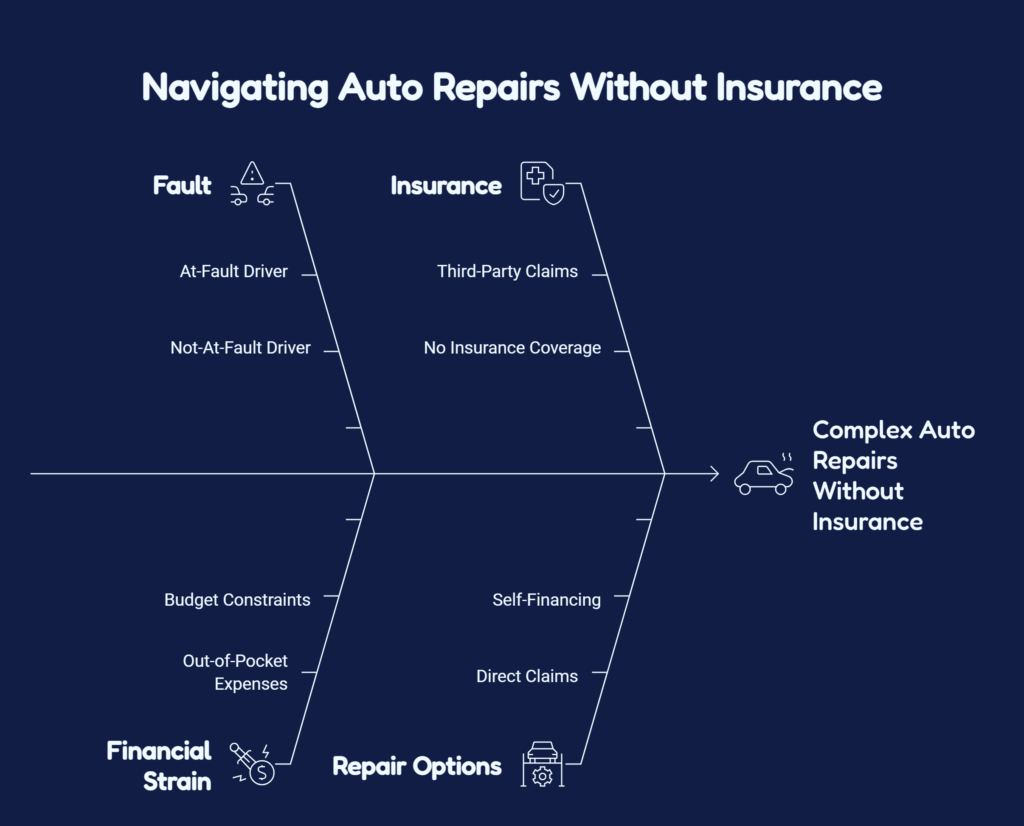
Managing Vehicle Repairs
Paying for car repairs out of pocket can strain any household budget. If you find yourself wondering how to get your car fixed after an accident without insurance, your options depend heavily on who caused the wreck:
- When You Are Not At Fault: You can file a third-party property damage claim directly against the at-fault driver’s insurance provider.
- When You Are At Fault: You are entirely responsible for financing your own vehicle restorations.
Many drivers wonder: can you negotiate repair and medical costs? The answer is yes. Auto body shops are often willing to work out scaled-back repair plans or utilize certified aftermarket parts instead of expensive original equipment manufacturer (OEM) components to keep your costs down.
Handling Healthcare Costs
An uninsured car wreck often leaves individuals on the hook for major hospital bills. If you do not have auto liability or health coverage, you may have to explore various options for financing repairs and medical expenses, such as medical liens or structured payment plans negotiated directly with the hospital’s billing department. If medical bills start to mount after an injury, exploring specialized healthcare networks like our breakdown on Private Healthcare Systems (PHCS) PPO networks can help clarify how specific network billing practices operate.
Additionally, you can look into community resources for financial assistance. Local non-profits, state-sponsored medical clinics, and victim compensation funds can sometimes provide a financial buffer for individuals facing unexpected medical crises without structured insurance safety nets.
4. Fault, Settlements, and Legal Realities
The intersections of fault and legal defense vary wildly based on the exact nature of your accident.
Debunking Fault Myths
A common question asked by drivers is: are uninsured drivers automatically at fault? The straightforward answer is no. An individual’s lack of insurance is a serious regulatory violation, but it does not automatically dictate the physics or the mechanics of the actual accident. If a driver runs a red light and strikes your vehicle, they are still fundamentally at fault for causing the accident, even if you were driving without a valid policy.
However, several jurisdictions enforce “No Pay, No Play” laws. In these states, an uninsured driver is barred from collecting non-economic damages (such as compensation for pain and suffering), even if they were completely innocent in the wreck.
Lawsuits and Asset Exposure
If you cause an accident while driving uninsured, the financial implications are stark. Many individuals turn to online forums out of panic, sharing phrases like “I am being sued for a car accident no insurance” to find peer guidance.
When you face a lawsuit from an insurance carrier or an injured party, your personal assets, including bank accounts, future wages, and property, can be placed at risk via court judgements. If you find yourself trapped in deep corporate or policy disputes, you may want to consult our comprehensive Life Insurance Lawyer Guide to see how professional legal evaluation operates when navigating complex liability frameworks.
Scenario: Uninsured and At Fault
- Personal liability for all physical and property damages
- Personal asset exposure and potential wage garnishment
- Direct driver’s license suspension risks
Scenario: Uninsured and NOT At Fault
- May collect property damage from the at-fault party’s insurance
- Subject to state-level “No Pay, No Play” compensation limits
- Still faces separate fines or suspensions for driving uninsured
Navigating Settlements
When determining how to discuss settlements and compensation without an insurer acting as your intermediary, extreme caution is required. Many people ask: is it illegal to settle an accident without insurance? It is generally not illegal to coordinate a private cash settlement for property damage, but doing so without formal, signed liability releases leaves you highly vulnerable to future claims. Furthermore, if you are looking to recover costs from an uninsured negligent party, you must evaluate: is it worth suing someone with no insurance? If the at-fault driver has no insurance and no tangible assets, winning a lawsuit might leave you with an uncollectible judgment.
5. Preventing Future Risks: How to Secure Car Insurance
Resolving an uninsured accident should serve as a turning point for establishing long-term financial security. Securing continuous coverage is the single best way to avoid repetitive logistical crises.
Steps to Obtain Coverage After an Accident
There are specific steps to obtain car insurance after an uninsured accident. First, you must resolve any active state suspensions or outstanding court fines. Once your driving privileges are legally restored, you can approach standard or non-standard insurance carriers to request quotes.
Understanding Premium Factors and Coverage Types
When shopping for a plan, it helps to review the core types of car insurance coverage explained:
- Liability Coverage: Pays for bodily injury and property damage you cause to others.
- Collision Coverage: Fixes your own vehicle after an accident, regardless of fault.
- Comprehensive Coverage: Protects against non-collision incidents like theft, fire, or vandalism.
Be prepared for dealing with increased premiums after an accident. Insurance underwriters look closely at your past driving record and any coverage lapses. When understanding insurance premium factors, a recent history of driving uninsured flags you as a high-risk candidate, meaning your initial monthly premiums will likely be higher than average. To discover more about broad state-by-state insurance oversight and consumer protection rules, you can review details provided by the National Association of Insurance Commissioners on the NAIC Official Website.
6. FAQs About Uninsured Car Accidents
Do cops know if you’re uninsured?
Yes. Modern law enforcement vehicles are frequently equipped with Automated License Plate Readers linked to real-time state databases that instantly flag vehicles lacking active insurance registries.
What happens if someone hits me and they are not insured?
If you carry uninsured motorist coverage, you can file a claim with your own provider. If you lack that coverage, your primary recourse is filing a personal lawsuit against the driver, though collecting funds can be difficult if they lack assets.
Is it ever too late to make an insurance claim?
Every state establishes a specific statute of limitations for property damage and bodily injury claims. While it is best to report accidents immediately, the legal window can range from one to several years depending on local laws.
What is the longest you can go without car insurance?
Legally, you cannot drive for even a single second without meeting your state’s financial responsibility laws. If your vehicle is parked and completely non-operational, you can occasionally drop coverage, but a lapse on an active registration can generate automated system fines.
What is the 80% rule for insurance?
In general insurance contexts, the 80% rule dictates that a policyholder must maintain insurance coverage equal to at least 80% of the total value of the insured asset to collect full replacement payouts on partial losses.
How much compensation can you get from a car crash?
Compensation varies completely based on total medical expenses, verified lost wages, vehicle repair estimates, and overall coverage limits.
Will my insurance go up if a car accident is not my fault?
Users frequently worry about premium hikes following a non-at-fault accident. In some states, regular rate adjustments or the loss of a claim-free discount can cause a minor premium increase, while other states strictly prohibit insurers from raising rates for non-at-fault claims.
Understanding what happens without coverage makes it even clearer why the right policy matters. For a full breakdown of coverage types and how to choose a provider that won’t leave you exposed, read The Secret Auto Insurance Guide to Outsmart Your Provider.
7. Conclusion
Navigating a car wreck without insurance is a stressful experience that highlights the vital protection a reliable policy provides. While an uninsured accident can lead to steep fines, court battles, and out-of-pocket expenses, understanding your legal obligations can help you handle the aftermath more effectively. Focus on securing proper documentation, exploring structured payment options for medical bills, and re-establishing valid coverage as quickly as possible to protect your financial future.