Making Insurance Simple, One Insight at a Time.

Custom Motorcycle Insurance: Coverage, Rates & How to Protect a Modified Bike
Custom motorcycle insurance explained: custom parts coverage, what affects rates, how to insure a modified bike, and what to ask before you buy.
Quick Summary
Custom motorcycle insurance protects a bike whose value comes from modifications a standard policy may not fully recognize, such as custom paint, aftermarket wheels, and engine upgrades. This guide explains the core coverages, how custom parts and equipment coverage works (including real limits from Progressive), why some bikes can only get liability coverage, and what raises or lowers your rate.
It also covers when a specialty insurer such as Hagerty makes sense and what to document before you file a claim. Insuria Insights is an educational site and does not sell insurance.
Table of Contents
Table of Contents
1. What Custom Motorcycle Insurance Covers
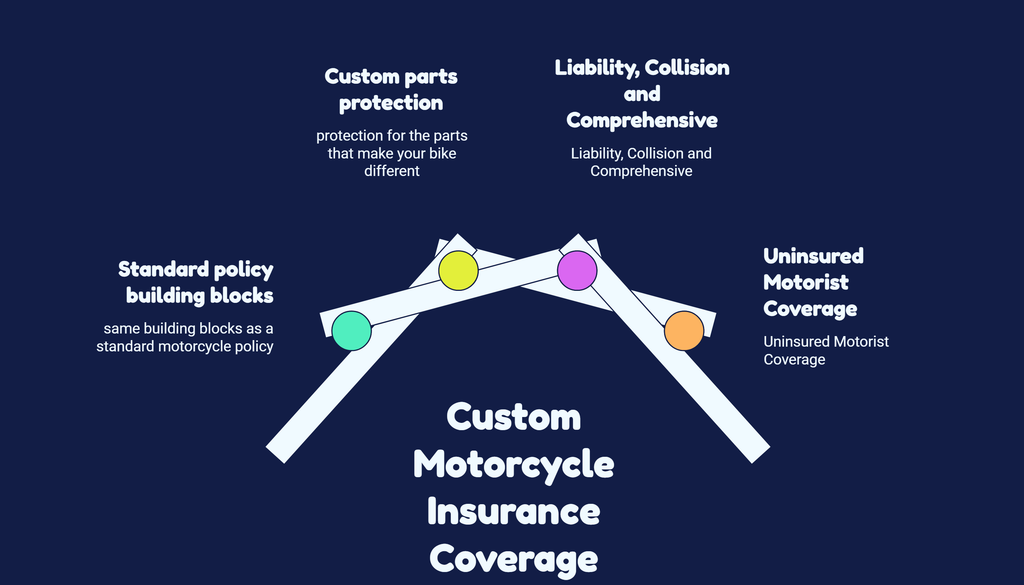
Custom motorcycle insurance starts with the same building blocks as a standard motorcycle policy, then adds protection for the parts that make your bike different.
Liability, Collision and Comprehensive
Liability coverage is the legal foundation of any custom motorcycle insurance policy. It pays for injuries and property damage you cause to others, but it does nothing to repair your own bike or its modifications. Collision coverage pays to repair your motorcycle after a crash, and comprehensive coverage pays for non-collision losses such as theft, vandalism, fire, and weather damage.
For a custom bike, these two parts of custom motorcycle insurance matter most, because modifications are expensive to replace and attractive to thieves.
Uninsured Motorist Coverage
Even a careful rider cannot control who else is on the road. Uninsured and underinsured motorist coverage can help pay for your injuries and, in some states, your bike if you are hit by a driver with no insurance or by a hit-and-run driver. Availability and rules vary by state, so ask your insurer how it applies where you ride.
2. Custom Parts, Equipment and Bike Value
This is the section that separates custom motorcycle insurance from an ordinary policy, and it is where many owners find out too late that their modifications are only partly covered.
How Custom Parts and Equipment Coverage Works
Custom parts and equipment (CPE) coverage, often called accessory coverage, pays for add-ons such as custom paint, wheels, seats, saddlebags, windshields, chrome, handlebars, and electronics. Progressive says it automatically includes $3,000 of accessory coverage with comprehensive, or comprehensive and collision, and that customers can buy more, up to $30,000 for most vehicle types.
Progressive also states that its accessory coverage never depreciates customized parts, and a deductible applies to claims. Other insurers set their own limits, so ask each one for the figure and whether it depreciates parts.
If your paint, wheels and engine work add up to more than the included amount, the gap comes out of your pocket. Raise the limit whenever you add significant upgrades, and do it before a loss rather than after.
Bikes That Can Only Get Liability Coverage
Not every custom build qualifies for full custom motorcycle insurance coverage. Progressive’s custom motorcycle insurance page says full coverage requires the bike to be listed in the NADA Appraisal Guide, and that bikes not in the guide, or built from a kit or individual parts, get liability coverage only. Examples it gives include kit or homemade bikes, bikes with a replaced original frame, bikes with a state-assigned VIN, and rebuilt or retitled bikes. If you have built or heavily rebuilt a bike, ask this question first.
Agreed Value and Guaranteed Value
Standard policies often pay actual cash value, which is the market value minus depreciation. For a bike whose value comes from custom work, that can fall well short. Some specialty insurers instead set a value in advance.
Hagerty, for example, calls its version Guaranteed Value, and says its Vehicle Under Construction coverage automatically increases a bike’s Guaranteed Value by 10% per quarter, up to a maximum increase of $25,000. Ask any insurer how it values a total loss and how you document the value of your work.
Disclose Your Modifications
Tell your insurer about every modification, including performance upgrades. Progressive’s own example is a turbo or nitrous oxide kit. Undisclosed changes can lead to a reduced or denied claim, so accuracy on the application protects you.
3. What Affects Custom Motorcycle Insurance Rates
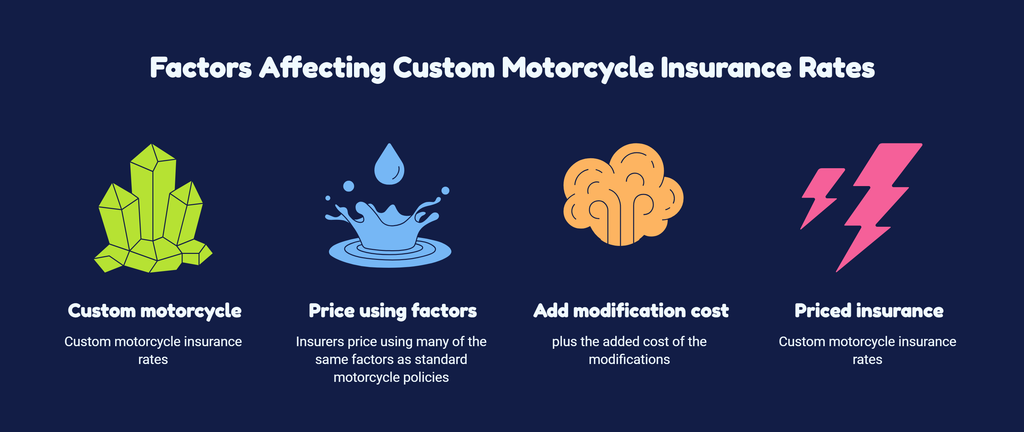
Insurers price custom motorcycle insurance using many of the same factors as standard motorcycle policies, plus the added cost of the modifications.
Modifications and Bike Value
Every modification adds to what an insurer might have to repair or replace, which tends to raise the premium. A higher insured value and a higher custom parts limit both push the price up, which is the tradeoff for better protection.
Where You Live and Park
Rates vary by location because of local theft, weather, and accident patterns. A bike parked in a locked garage in a low-theft area is generally cheaper to insure than one parked on a street in a high-theft one.
How You Ride
A show bike that rarely leaves the garage presents a different risk than a custom daily commuter. Mileage, riding experience, and your driving record all play a role, and insurers also ask about whether the bike is used for racing, which many standard policies exclude.
4. How to Lower Your Custom Motorcycle Insurance Cost
The most dependable ways to reduce a custom motorcycle insurance premium are not tricks. Bundling a motorcycle with a home or auto policy often earns a multi-policy discount, so ask for one. A higher deductible lowers your premium, but only choose one you could comfortably pay out of pocket after a loss.
Completing an approved rider safety course may earn a discount with some insurers, and a clean record with no recent tickets or at-fault accidents keeps rates down over time.
Most important, compare more than price. Look at the liability limits, the custom parts limit, whether parts depreciate, how a total loss is valued, and what the policy excludes. Two quotes that look similar can protect very different amounts. For the broader principles behind premiums, see our Auto Insurance Guide (2026): How to Lower Your Premiums.
5. Choosing an Insurer for a Custom Bike
Mainstream insurers such as Progressive write custom motorcycle insurance for customized bikes within their limits and eligibility rules. Geico, Dairyland, and Harley-Davidson Insurance also write motorcycle policies, so ask each how it treats modifications and what its custom parts limit is.
When a Specialty Insurer Makes Sense
Hagerty insures classic and collector motorcycles and says modified motorcycles are covered. According to Hagerty’s motorcycle insurance page, custom-built or structurally modified bikes must meet extra rules: the motorcycle must be from 1975 or older, with a minimum insured value of $7,500, and custom-built trikes are not eligible. Coverage does not apply when the bike is on-track, and Hagerty’s motorcycle coverage applies within the United States only. A specialty insurer is most useful for older, restored, or high-value builds, so check eligibility before assuming it fits your bike.
6. Filing a Claim on a Custom Motorcycle
Claims under custom motorcycle insurance usually involve more paperwork because the insurer must verify the value of the parts. Before you ever need to file, keep photos of the bike from several angles, a list of every modification with receipts, and an appraisal if your insurer or an appraiser offers one.
After a loss, document the damage with photos, file a police report if required, contact your insurer promptly, and keep the build records ready. Update your coverage whenever you add major parts, so your limits keep up with the bike.
7. Frequently Asked Questions
Does Hagerty insure custom motorcycles?
Hagerty insures classic and collector motorcycles and says modified motorcycles are covered. Custom-built or structurally modified bikes must be 1975 or older with a minimum insured value of $7,500, and custom-built trikes are not eligible.
Who offers custom motorcycle insurance for modified bikes?
Many mainstream insurers cover modified bikes within their rules, and Progressive includes $3,000 of accessory coverage that can be raised up to $30,000. Eligibility depends on the bike, and kit-built or rebuilt bikes may only qualify for liability coverage.
Do I have to tell my insurer about modifications for custom motorcycle insurance?
Yes. Disclose all modifications, including performance parts, because undisclosed changes can reduce or void a claim.
Who has the cheapest custom motorcycle insurance?
No single insurer is cheapest for everyone. Price depends on your record, location, the bike, and your coverage limits, so compare quotes from several insurers.
Is custom parts coverage included in custom motorcycle insurance?
Often a limited amount is, usually when you have comprehensive coverage. Progressive includes $3,000, and many riders need to buy more.
8. Conclusion
Custom motorcycle insurance works best when you treat the modifications as a separate value to protect. Confirm your bike is eligible for full coverage, raise your custom parts limit as you build, disclose every change, and compare how insurers value a total loss before you buy.
If you are also thinking about riding other bikes occasionally, see our guide on One Day Bike Insurance: What Temporary Motorcycle Coverage Really Exists in the US.
Disclaimer: This information is provided for general educational purposes only and does not constitute professional insurance, legal, or financial advice. Coverage, limits, and eligibility vary by insurer and state and change over time. Always confirm details with a licensed insurance professional before making coverage decisions.